Staff Reporter
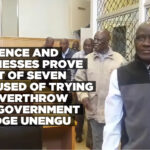
HIGH Court Judge Petrus Unengu, delivering a judgment against seven men accused of trying to overthrow the Namibian government in the Caprivi region between September 1998 and December 2003, said that through evidence from witnesses for the State, supported by documentary evidence, it was clear that all the accused connived to fight the legitimate government. They regarded the government as an intruder in their perceived country and acted in cohorts with hostile intentions to drive out the perceived enemy (the government) from the then Eastern Caprivi Zipfel.
Unengu made these remarks in his judgment against the seven men, namely Progress Kenyoka Munuma, Shine Samulandela, Manuel Manepelo Makendano, Alex Sinjabata Mushakwa, Diamond Samunzala Salufa, Frederick Isaka Ntambila, and John Tembwe, who were found guilty on their main count of High Treason.
The accused were also found guilty on counts related to the unauthorized importation, supply, or possession of any cannon, recoilless gun, mortar, rocket launcher, contravening section 2(c) read with section 891(a) of the Departure from the Union Regulation Act, Act 34 of 1955, as amended by Section 2 of the Departure from Namibia Regulation Act, Act No. 4 of 1993, as well as contravening the Immigration Act, among others. The accused were arrested between July 2002 and December 2003 and charged in relation to taking part in a conspiracy aimed at overthrowing the Namibian government in the former Caprivi region between September 1998 and December 2003.
They were initially convicted and sentenced to terms ranging from 30 to 32 years by the late magistrate John Manyarara. However, their sentences were set aside by the Supreme Court on appeal in July 2013, and the trial started afresh, resulting in the current judgment by Justice Unengu.
In his new judgment, Unengu said that the defense lawyer Ilse Agenbach contended that the State did not prove the meetings the accused allegedly attended or held, adding that her clients were tortured by the police and soldiers. However, this allegation was denied by her clients during cross-examination, and they indicated that they did not tell counsel that they were tortured or harassed by the police and soldiers.
“In this case, it is common knowledge that after he defected from the Democratic Turnhalle Alliance Party (the DTA), Mr. Mishake Muyongo retreated to his Mecca, the then Eastern Caprivi region, and organized various clandestine meetings with the inhabitants of the region, in particular, those from the western part of the region. The meetings were disguised as political meetings, whereas in fact, they were meetings where they conspired to acquire weapons from neighbouring countries to use to violently secede the region from the rest of the Republic of Namibia. In the meetings, it was also resolved to form an army named the Caprivi Liberation Army (CLA). It is further common cause that some of the people recruited during the meetings, including the accused before the court, went to Angola via the western part of Zambia where weapons, ammunition, and other types of weapons of war were obtained from UNITA in Angola and smuggled into Namibia through undesignated exit and entry points between Namibia and Zambia. The majority of the accused before the court were part of the group that obtained weapons, hid them in the forests under the watchful eyes of some of the newly recruited CLA soldiers. At this time, everyone was aware and knew the purpose the weapons were obtained for because immediately thereafter, they trained how to use these weapons,” Judge Unengu said.
He further added that it is not in dispute that weapons procured were used in the attack on 2 August 1999 and the killing of Victor Falali, after which a group of people, including some of the accused, fled to Botswana to avoid reprisal from the security forces of the government.
“The government of the Republic of Namibia offered and encouraged them to come back to Namibia through voluntary repatriation without any consequences of possible prosecution. Others accepted the offer and were repatriated back home and were granted indemnity from prosecution, but the accused and others refused the offer and remained behind, just later to sneak and to bolt out from the camp to Namibia through illegal ports of entry. While in Namibia, in the former Caprivi Region, the accused camped in various forests preparing for an attack on public installations. Their intentions were clear from their conduct since the day they were recruited; it was a conspiracy with hostile intent to overthrow the legitimate government of the country from the then Eastern Caprivi Region,” Judge Unengu said.
He added that the accused were not only poor, unreliable, and untrustworthy, but also dishonest, and tried all tricks in the world to mislead the court, starting from the first special plea when they challenged the jurisdiction of this Court, alleging that they were abducted or kidnapped by the Namibian security forces from Botswana to Namibia where they were granted refugee status by the United Nations High Commissioner for Refugees, while knowing well that their refugee status was revoked by the same High Commissioner; therefore, they were illegal immigrants in Botswana.
“After failing in the first special plea, the accused again came up with another fairy tale, a second special plea alleging, among others, that the then Eastern Caprivi Region did not form part of the rest of Namibia as it did not form part of the region then known as German Southwest Africa. Above all, their version is outright a bare denial of the crimes brought against them. They failed to present evidence which could be regarded by the court as reasonably possibly true to cast doubt in the mind of the court,” Unengu said.