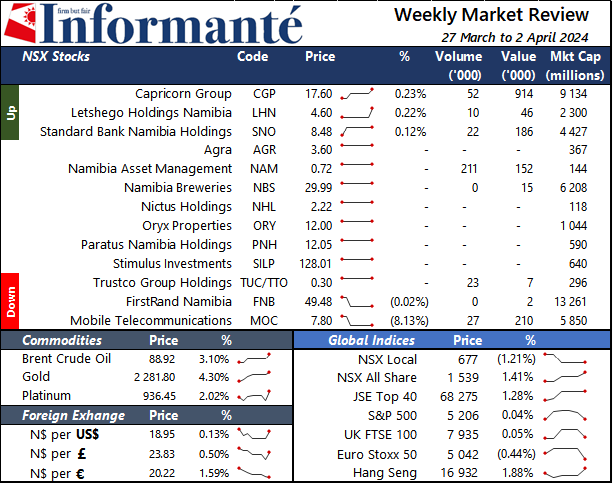
This week, the NSX Local index declined by 1.21%, closing at 677.4, while the NSX Overall Index increased by 1.41%, closing at 1539.4. As of April 2, 2024, FirstRand Namibia emerged as the largest local company on the exchange, boasting a market capitalization of N$ 13.3 billion. It was followed by Capricorn Group with N$ 9.1 billion, Namibia Breweries with N$ 6.2 billion, and Mobile Telecommunications with N$ 5.9 billion. Capricorn Group led the market this week, closing at N$ 17.6 per share, reflecting a growth of 0.2%. Letshego Holdings Namibia followed suit, closing at N$ 4.6 after also posting a growth of 0.2%. In terms of trading volume, Capricorn Group led the market with N$ 0.9 million worth of shares traded. Mobile Telecommunications followed with N$ 0.2 million worth of shares traded. On the currency front, the local currency appreciated by 0.13% against the US Dollar, closing at N$ 18.95 per USD. It also gained 0.50% against the British Pound, closing at N$ 23.83 per GBP, and appreciated by 1.59% against the Euro, closing at N$ 20.22.
Namibia’s economic growth moderated in 2023 according to the latest Annual National Accounts data released by the Namibia Statistics Agency. The domestic economy expanded by 4.2% in real terms during the year, decelerating from the 5.3% growth recorded in 2022. The slowdown in growth can be attributed to weakening performance in both the Primary and Secondary industry sectors. The Primary industries posted 9.7% growth, down from 13.7% in the prior year. This was driven by weaker diamond demand and high inventory levels that suppressed production. However, the ‘Other mining and quarrying’ segment surged 37.2% on the back of new oil exploration discoveries. Additionally, the Uranium subsector rebounded due to elevated energy demand and favourable international pricing. The Secondary industries advanced by a modest 2.0%, compared to 3.4% growth in 2022. This sluggish expansion was largely a result of the Manufacturing sector contracting by 3.2%, following 5.2% growth a year earlier. Compounding matters, the Construction sector posted its eighth consecutive year of contraction amid persistently subdued construction activity levels. A bright spot was the Tertiary industries, which saw growth accelerate to 2.7% for the period under review. This improved performance was broad-based across major subsectors, with the exception of Public Administration and Defence, which faced headwinds from the government’s fiscal consolidation policy aimed at curbing expenditure.