Staff Reporter
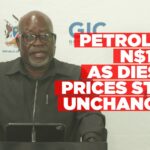
NEW fuel prices will take effect next week Wednesday. Petrol 95 will increase by N$1.50 per litre to N$26.58 from 7 October 2026, while the prices of Diesel 50 ppm and Diesel 10 ppm will remain unchanged at N$27.86 and N$27.96 per litre, respectively, the Ministry of Industries, Mines and Energy announced today.
Minister of Industries, Mines and Energy Modestus Amutse said the decision followed a review of international oil prices, the exchange rate and the cost of importing petroleum products into Namibia.
He said the ministry had recorded significant increases in international petroleum product prices during the review period, driven by geopolitical tensions, supply disruptions in the Middle East, attacks on oil infrastructure and constraints on flows through the Strait of Hormuz.
According to Amutse, the average international price of Petrol 95 increased by 19.27% during the period from 1 to 25 September 2026, rising from US$124.39 per barrel in August to US$148.36 per barrel.
The average price of Diesel 50 ppm increased by 13.60%, from US$160.58 per barrel to US$182.41, while Diesel 10 ppm increased by 13.52%, from US$161.48 to US$183.31 per barrel.
The Namibian dollar also weakened slightly against the US dollar during the review period, further increasing the cost of importing fuel.
Amutse said the ministry’s calculations showed provisional under-recoveries of 379.64 cents per litre for Petrol 95, 358.41 cents per litre for Diesel 50 ppm and 357.59 cents per litre for Diesel 10 ppm.
Despite the under-recoveries, the ministry decided to increase only the petrol price and retain the current prices of both diesel grades.
Amutse said the decision was taken after officials considered various options, particularly the potential impact of higher diesel prices on industries and producers.
“Diesel is consumed by many factories and producers who are a country that is advocating industrialisation,” he said.
He said the ministry would continue monitoring international oil markets during October, with the next fuel price review potentially resulting in further changes.
Amutse also assured the public that Namibia currently has adequate fuel stocks and that there is no immediate risk of fuel shortages.
“The fuel supply chain remains operational and stable with sufficient stockholding levels maintained by oil marketing companies to meet national demand,” he said.
Government interventions to cushion consumers from international oil price shocks will also continue through the National Energy Fund (NEF) and the Bulk Petroleum Import Coordination Mechanism (BPIC).
Amutse said the government had made progress in reforming the importation of bulk fuel into Namibia through the BPIC mechanism.
He said Namibia began benefiting from the mechanism in July 2026 when the government made emergency fuel supply arrangements with Vitol to supply bulk fuel at the Basic Fuel Price (BFP), effectively eliminating additional premiums that would otherwise have been charged.
The government estimates that additional premiums between July and October 2026 would have resulted in losses of between N$400 million and N$700 million at the macroeconomic level.
For the period from November 2026 to January 2027, the government conducted a competitive bidding process for bulk fuel supply, with four domestic oil companies and their strategic partners or affiliates participating.
TotalEnergies Marketing Namibia, together with its trading partner TOTSA, emerged as the successful bidder, offering a weighted net discount of 63.85 cents per litre on the BFP.
Amutse said this was expected to result in an estimated saving of approximately N$220.5 million at the macroeconomic level.
He clarified that a discount on the BFP does not necessarily mean fuel prices at the pump will decrease, as the BFP is influenced by the international product price, the exchange rate and shipping costs.
“The BFPs for November 2026, December 2026 and January 2027 are yet unknown,” he said.
Amutse said the discount would nevertheless provide savings regardless of where the BFP is set during those months.
“If the BFP happens to fall, Namibia will benefit twice in terms of a fall in pump prices and an extra saving on top due to the discount on the BFP,” he said.
Namibia remains a net importer of petroleum products and has limited control over international oil price movements.
Amutse said the government would continue monitoring international developments while using measures such as the NEF and BPIC mechanism to support fuel supply security, economic stability and critical sectors of the economy.
Photo: Ministry of Information and Communication Technology