Staff Reporter
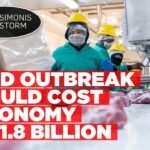
THE Foot-and-Mouth Disease (FMD) outbreak in Namibia could cost the economy about N$1.8 billion over 2026 and 2027 in the base case, with growth expected to slow to around 2% this year as livestock movement restrictions disrupt farming, meat processing, exports and rural incomes.
According to an economic assessment by the Simonis Storm Research Team, the outbreak is expected to reduce 2026 economic growth by about 0.45 percentage points from a pre-outbreak estimate of 2.5%, with the length of the nationwide movement ban identified as the key factor determining the eventual economic impact.
The assessment follows confirmation on 23 September of FMD on a commercial farm in the Karasburg State Veterinary District in the //Kharas Region. Of 11 cattle showing clinical signs that were sampled, 10 tested positive at the Central Veterinary Laboratory, while local reports put the number of cattle showing clinical signs at 63.
The outbreak occurred inside Namibia’s internationally recognised FMD-free zone south of the veterinary cordon fence, prompting a nationwide suspension of the movement, marketing and trade of cloven-hoofed animals and their products, as well as imports, exports and transit.
Simonis Storm said the location of the outbreak is particularly significant because the southern free zone supports Namibia’s premium beef exports to markets including the European Union, United Kingdom and Norway.
Beef exports are estimated at about N$5.5 billion annually, with approximately N$3.3 billion coming from the EU, UK and Norway. The EU alone accounted for 13.3 million of the 22.7 million kilograms of beef Namibia exported in 2024.
The research team estimates that Namibia could lose about N$1.5 billion in exports in 2026 under its base case, although some of the impact would be offset by lower imports as economic activity and household spending weaken.
The economic impact extends beyond beef, with dairy, pork, leather and game also affected by restrictions on cloven-hoofed animals and their products.
Livestock farming contributes about 2.3% of GDP based on value added, while livestock farming, meat processing, the game sector and smaller related industries account for roughly N$8.8 billion in annual value added, or about 3.1% of GDP, according to the assessment.
The research team estimates that every N$1 lost at farm level removes about N$1.65 of output across the wider economy as the effects spread to transport, feed, veterinary services, auctioneers, packaging, utilities and other businesses.
Around 12,000 job years could be lost across 2026 and 2027, although Simonis Storm cautioned that the employment estimate remains subject to further calibration against Labour Force Survey data.
More than 100,000 rural households hold cattle as a form of wealth, meaning the movement ban also prevents farmers from selling livestock to meet expenses such as school fees, debt repayments and feed costs.
The outbreak also comes at a difficult time for the livestock sector, which had begun recovering after drought-related destocking. Cattle marketings were up 28% to July 2026, while agriculture grew 17.8% year on year in the second quarter.
The assessment warns that animals which cannot be marketed must instead be maintained on farms, increasing feed costs and putting pressure on farmers’ cash flow, particularly towards the end of the dry season.
The game industry is also exposed, with Simonis Storm estimating its value added at about N$870 million. Restrictions affecting game and game products could put hunting revenue, trophy fees, game meat and lodge bookings under pressure.
The outbreak has also interrupted the recovery of Meatco, whose cattle throughput south of the veterinary cordon fence had recovered to more than 34,000 head by the end of July, compared with 24,405 a year earlier.
Meatco had also taken over unused portions of Botswana’s Norway quota, valued at about N$100 million, with expected Norwegian exports for 2026 estimated at approximately N$365 million. The programme is now at risk because of the FMD restrictions.
Savanna Beef, the producer-owned export abattoir near Okahandja, is also exposed after receiving its export certificate in July. The company has about 730 shareholders who have invested roughly N$400 million, with the plant expected to employ about 240 people at full operation.
Simonis Storm said the plant’s high fixed costs and limited operating history make it particularly vulnerable to a prolonged interruption.
The assessment estimates that farmers could lose about N$890 million in sales income during 2026 under the base case. However, because animals that cannot be sold are recorded as inventory held on farms, only about N$530 million of this would appear as lower GDP.
This means official GDP figures could understate the immediate financial pressure experienced by farmers, as cash flow stops while wages, loan repayments and feed costs continue.
The banking sector could also face increased pressure as agricultural borrowers seek loan restructuring, while livestock and farmland values could weaken. Agribank already had reported arrears of between N$1.1 billion and N$1.2 billion in 2024.
The outbreak is also expected to affect consumer prices in the short term. Simonis Storm estimates that the disruption could add about 0.29 percentage points to headline inflation in the fourth quarter, mainly through meat and dairy products.
However, the research team expects local beef prices to decline once slaughtering resumes while premium export markets remain closed, as beef intended for export is redirected to the smaller domestic market.
The assessment estimates the government’s fiscal cost at about N$1.8 billion over 2026 and 2027 in the base case, including approximately N$800 million in lost tax revenue. A more severe outbreak could raise the fiscal cost to about N$4.39 billion.
The research team said Namibia’s ability to restore its FMD-free status and regain premium export markets will depend on the speed and effectiveness of disease control.
While Namibia could potentially restore its World Organisation for Animal Health (WOAH) status relatively quickly if the outbreak is contained and eradicated, bilateral export protocols with individual markets could take considerably longer to restore.
Simonis Storm estimates that full premium market access could take 12 to 24 months, as importing countries would require audits, surveillance and renegotiation of export protocols.
Historical evidence cited in the assessment shows that 88% of 45 suspensions of FMD-free status recorded by WOAH between 1996 and 2020 were eventually resolved, with three out of four recovering within two years.
The research team said stamping out outbreaks historically resulted in faster recovery than vaccination and maintaining infected animals, although the choice of control strategy remains a decision for the veterinary authorities.
It also warned that South Africa’s move towards mass vaccination could create a longer-term challenge for Namibia’s disease-free zone, given the country’s geographical proximity and livestock links with South Africa.
Simonis Storm said the most important immediate indicator would be whether the nationwide restrictions can be narrowed to the affected area.
A rapid regionalisation of the restrictions would allow abattoirs outside the //Kharas Region to resume operations and could give international buyers a basis to accept the unaffected areas of Namibia’s free zone.
The research team said each additional week of a full nationwide ban could reduce economic growth by roughly 0.02 to 0.03 percentage points.
It expects the October and November livestock marketing figures, together with veterinary surveillance and decisions on regionalisation, to provide the clearest indication of the eventual economic impact.
The assessment concludes that while the national economy is expected to remain capable of absorbing the shock, the consequences for farming communities, farm workers, abattoir towns and rural businesses could be severe.
Simonis Storm estimates that about N$1.36 billion of output could be lost across the economy in 2026 under its base case, with farms, abattoirs and the game industry accounting for about N$840 million and the remainder affecting retail, transport, business services, utilities and finance.
The research team said the outbreak demonstrates the importance of biosecurity and prevention, warning that the economic cost of an FMD outbreak can extend well beyond the farms where the disease is detected.
Photo: Meatco