Staff Reporter
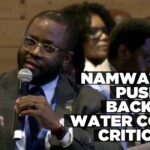
THE Namibia Water Corporation’s (NamWater) Head of Public Relations and Corporate Communications, Lot Ndamanomhata, has argued that NamWater has been very considerate when it comes to supplying water at an affordable rate, as the corporation’s tariffs have not been adjusted for more than five years.
“NamWater has not received a tariff adjustment since 2019. None of our prices have changed since 2019. We could have. We have applied for those tariff adjustments because now we are operating on costs based on 2019. People are saying that the water is expensive. The most rational thing is to say ‘supply it for free,’ of course. That’s most logical. I would want that, but what are you doing to the corporation? You are going to bankrupt it,” he continued.
He made these remarks in response to a question from Shivute Indongo, Executive Director within the Office of the Prime Minister, at the 2026 Africa Public Service Day in Swakopmund. This year’s event aimed to bring together government leaders, development partners, public servants and stakeholders from across the country to facilitate discussions focused on sustainable solutions for water and sanitation.
Indongo expressed concern about the affordability of water in Namibia, arguing that many people, particularly in rural areas, struggle to access water because it has become overly commercialised.
“Is water sustainable or is it affordable? What I’m seeing is that we are providing water and, at the same time, before we reach the goal, all the municipalities, all the town councils, whoever, they are busy cutting water for the people. And we are saying that water is a basic service. I think the problem in Namibia is that we are commercialising water too much,” Indongo said.
In response, Ndamanomhata maintained that NamWater should not be blamed for increases reflected on consumers’ municipal bills, arguing that local authorities are responsible for rates and taxes.
“If you see a change on your rates and taxes, it’s your local authority, not NamWater. That I can confidently say. We have been considerate and we have not made any changes,” Ndamanomhata said.
He cited the Erongo Region as an example, explaining that NamWater purchases desalinated water from the Orano Desalination Plant at N$55 per cubic metre but sells it for N$14 per cubic metre, absorbing the difference instead of passing the full cost on to consumers.
However, Ndamanomhata said it is unrealistic to expect water to be supplied free of charge under the country’s current economic system. He argued that the debate should instead focus on the funding gap for water infrastructure, which he said remains inadequate.
“NamWater does not receive an annual subsidy, for instance, to expend water services, even in rural water supply, but government complements us with making funding available. For instance, the Rundu Water Treatment Plant for N$665 million, that is funding that government got for us to be able to supply that water treatment to Rundu. Another addition is to say, Oshakati Water Treatment Plant, 743 million – again, that is government funding because we can’t go out to the market and say ‘let’s get this money, let’s get this loan,” government makes that money available,” Ndamanomhata continued.
He also pointed to the N$200 million Naute-Keetmanshoop Pipeline and the N$2.1 billion Erongo SUNam Desalination Plant, a joint venture between Swakop Uranium and NamWater, as examples of government-backed investment in water infrastructure.
“Is there a funding deficit in the water infrastructure? We agree, it is. Do we need additional money for that funding? Yes we do. But how do we ensure that we get that funding without necessarily constraining the fiscus that we have right now. Our current fiscus cannot expand, and we must be realistic about that. We’ve got so many priorities that we facing,” Ndamanomhata added.
Photo: Ministry of Information and Communication Technology – Republic of Namibia