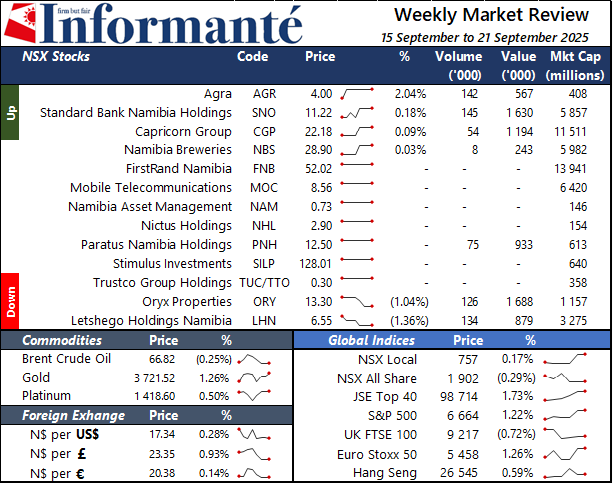
Namibian equity markets delivered contrasting results this week, with the NSX Local index advancing 0.17% to close at 756.8 points, while the NSX Overall Index declined 0.29% to finish at 1902 points. As of September 21, 2025, FirstRand Namibia has further strengthened its position as the largest local company on the exchange, with its market capitalization reaching N$13.9 billion. Capricorn Group maintains second place with a market value of N$11.5 billion, followed by Mobile Telecommunications at N$6.4 billion and Namibia Breweries at N$6.0 billion. Agra led the market this week, with its shares rising 2.0% to close at N$4 per share. Standard Bank Namibia Holdings secured second place among gainers, advancing 0.2% to settle at N$11.22. Trading activity was dominated by Oryx Properties, which saw N$1.7 million worth of shares changing hands during the period. Standard Bank Namibia Holdings recorded the second-highest trading volume with N$1.6 million worth of shares traded. The Namibia Dollar strengthened against all major currencies this week. It gained 0.28% against the US Dollar to close at N$17.34, advanced 0.93% against the British Pound to finish at N$23.35, and strengthened 0.14% against the Euro to end at N$20.38.
Namibia’s disinflationary trend accelerated in August 2025, with the headline annual inflation rate declining to 3.2 percent from the 4.4 percent recorded in August 2024. This represents the lowest annual inflation reading in recent months, providing continued relief for consumers and reinforcing the central bank’s price stability objectives. Monthly price movements returned to zero growth, with the inflation rate registering 0.0 percent on a month-on-month basis, down from the 0.1 percent increase recorded in July. This flatlining of monthly price pressures suggests a temporary pause in inflationary momentum across the economy. Regional inflation patterns showed a narrowing of disparities between zones compared to previous months. Zone 1, comprising the northern regions of Kavango East, Kavango West, Kunene, Ohangwena, Omusati, Oshana, Oshikoto, Otjozondjupa, and Zambezi, recorded the highest annual inflation at 3.6 percent. Zone 3, encompassing the //Kharas, Erongo, Hardap, and Omaheke regions, registered inflation precisely in line with the national average at 3.2 percent. The capital region, Zone 2 (Khomas), continued to experience the lowest inflation at 2.9 percent, maintaining its advantage from superior supply chain efficiency and competitive market dynamics. Analysis of inflation contributors reveals a shift in the relative impact of key categories. “Food and Non-Alcoholic Beverages” remained the primary driver but with reduced influence, contributing 1.0 percentage points to the headline inflation rate. Both “Housing, Water, Electricity, Gas, and Other Fuels” and “Alcoholic Beverages and Tobacco” contributed equally at 0.8 percentage points each, reflecting balanced price pressures across essential consumer categories.