
Maria David
FARMING should not be seen as an isolated endeavour; rather, farmers must strategically position themselves within the livestock value chain to reduce operational costs and boost efficiency.
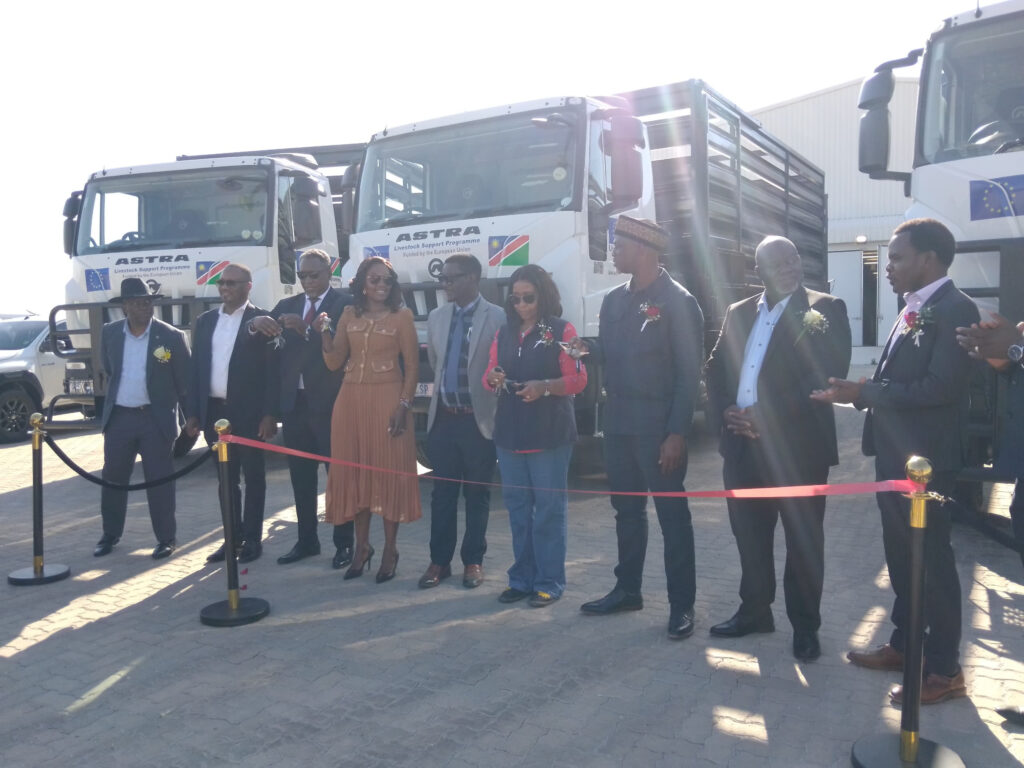
This was according to the Minister of Agriculture, Fisheries, Water and Land Reform, Ingenesia “Inge” Zaamwani, during the handover of five 30-ton livestock trucks with trailers and five portable loading ramps on Thursday at Ongwediva.
The significant N$20.6 million investment in these trucks aims to establish collection points in even the most remote areas, promoting greater offtake and improving market access for communal farmers.
Zaamwani emphasised that no single farmer should have to bear the entire burden of the full production cycle alone.
“The newly acquired trucks and trailers will be under the custodianship of Meatco, which will collaborate closely with farmers across the Northern Communal Areas (NCAs) to ensure fair and equitable transportation schedules,” she said.
She added that these vehicles are specifically earmarked to service all NCA abattoirs, including those in Katima Mulilo, Eenhana, Oshakati, Outapi, and Rundu.
“I call upon Meatco to safeguard and maintain these assets so they continue to deliver benefits for many years to come, supporting both current and future generations of farmers,” she urged.
She explained that the Livestock Support Programme was conceptualised to tackle long-standing structural challenges within the beef value chain. These challenges include issues related to animal husbandry, animal health, rangeland degradation, value addition, and marketing, all of which have historically prevented communal farmers from accessing profitable markets.
By enhancing mobility and increasing load capacity, Zaamwani indicated that the ministry is laying the groundwork for a more competitive, inclusive, and resilient livestock subsector.
She then encouraged farmers to consider specialising in various components of the value chain. This could mean some farmers focus on breeding, others on feedlots, and still others on the production of animal licks, livestock procurement, trading, or transportation.
She stressed that through such cooperation, a robust system that equitably benefits all stakeholders can be created.
Oshana Governor Hofni Iipinge echoed these sentiments, saying that this investment directly addresses the core of local economies where livestock farming is not just a livelihood, but a vital contributor to household incomes, food security, and rural employment.
Iipinge added that by reducing transportation costs and facilitating greater livestock offtake, this initiative promises to unlock new economic opportunities for communal farmers while simultaneously strengthening the beef value chain across the region.
“We welcome this development not only as an infrastructure boost, but as a catalyst for inclusive growth, one that will enable even the remotest farming communities to participate meaningfully in the formal livestock marketing system,” he concluded.