Staff Reporter
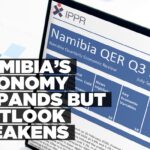
NAMIBIA’S economic growth outlook for 2026 has been revised down to 2.1%, while rising inflation and higher interest rates added pressure to the economy during the third quarter, according to the latest Namibia Quarterly Economic Review (QER).
The QER for July to September 2026, compiled by the Institute for Public Policy Research (IPPR), shows that the economy grew by 4.8% in the second quarter of 2026, marking the 21st consecutive quarterly increase since the recovery began in the first quarter of 2021.
Growth in the first quarter was also revised upwards to 3.1%.
Despite the quarterly growth, the overall outlook remains subdued. The Bank of Namibia’s August 2026 forecast puts GDP growth at 2.1% for 2026, down from its earlier forecast of 2.6%, before growth is expected to improve to 2.8% in 2027 and 3.2% in 2028.
The revised outlook follows weaker-than-expected economic growth in 2025. The Namibia Statistics Agency’s preliminary national accounts showed that the economy grew by 1.7% in 2025, compared with 3.8% in 2024.
The lower growth comes as Namibia continues to face pressure from weaker diamond production, declining gold output and other sector-specific challenges, although services and construction continue to support economic activity.
The QER shows that services accounted for 55.1% of economic activity in 2025, while primary and secondary sectors contributed 21% and 14.9%, respectively.
Most sectors recorded positive growth in 2025, led by construction, crop farming, electricity and water, ICT, trade, health, education and public administration.
However, manufacturing, mining and livestock farming recorded negative growth during the year.
Private fixed investment declined slightly in 2025 following exceptionally strong investment in 2023 and 2024, driven largely by oil and gas exploration.
Private non-mining investment nevertheless increased from 7.4% of GDP in 2024 to 7.8% in 2025.
Inflation also became a growing concern during the third quarter.
Namibia’s consumer inflation increased to 5.0% in August 2026, largely due to higher fuel prices, while inflation in South Africa reached 4.4%.
In response to rising inflation, the Bank of Namibia increased its repo rate by 25 basis points to 6.75% in June, marking the first increase in three years.
The South African Reserve Bank subsequently raised its repo rate from 7.00% to 7.25% on 23 September.
The Bank of Namibia’s next Monetary Policy Committee meeting is scheduled for 21 October.
Foreign exchange reserves stood at N$51.8 billion at the end of the second quarter, equivalent to 3.2 months of import cover and above the central bank’s three-month rule of thumb.
The ratio of non-performing loans reported by commercial banks also continued to decline, reaching 4.2% in the first quarter of 2026.
Private-sector credit extension to businesses recovered somewhat after peaking in mid-2025, while lending to households, including mortgage lending for housing, remained largely flat.
Formal-sector employment showed some improvement, with the number of active pension fund members increasing by 4.1% from 356,617 in 2024 to 371,070 in 2025.
New vehicle sales also increased, with combined commercial and private vehicle sales rising from 3,649 in the fourth quarter of 2025 to 3,832 in the first quarter of 2026.
Fuel prices fluctuated during the quarter, with petrol increasing from N$23.48 per litre at the start of July to N$25.08 by the end of September. The price of 10ppm diesel declined from N$28.36 to N$27.96 per litre over the same period.
The QER adds that the economic outlook remains dependent on developments in key sectors, investment activity and broader domestic and international economic conditions.
Picture for illustrative purposes only. Photo: Pexels