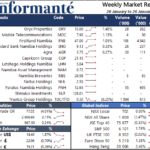
The Namibian Stock Exchange (NSX) showed divergent performance this week, with the Local index advancing 0.50% to reach 701.8 points, while the Overall Index declined by 1.47% to 1808 points. FirstRand Namibia maintains its position as the exchange’s dominant player as of January 26, 2025, with a market capitalization of N$12.6 billion, followed by Capricorn Group at N$11.0 billion, while Namibia Breweries and Mobile Telecommunications complete the top tier at N$6.0 billion and N$5.9 billion respectively. Oryx Properties emerged as the week’s leading performer, with shares appreciating 1.4% to close at N$13, closely followed by Mobile Telecommunications with a 1.2% gain to N$7.9. Trading activity was led by FirstRand Namibia, which saw N$4.9 million worth of shares exchanged, substantially ahead of Paratus Namibia Holdings at N$0.7 million. The Namibian Dollar demonstrated mixed performance against major currencies, strengthening notably by 1.87% against the US Dollar to N$18.40, while weakening against the British Pound by 0.70% to N$22.96 and marginally declining against the Euro by 0.26% to close at N$19.31.

The Namibian economy grew modestly in the third quarter of 2024, with its nominal size reaching N$61.6 billion, up N$5.3 billion from N$56.3 billion in the same period of 2023. In real terms, growth stood at 2.8%, slightly below the 3.1% recorded a year earlier. The tertiary industries were the primary drivers, expanding by 4.9% in real value added, led by strong performances in health (16.0%), financial services (7.1%), and transport and storage (7.9%). Meanwhile, the secondary industries rebounded with 1.5% growth, fuelled by recoveries in manufacturing (2.6%) and construction (1.6%). However, the primary industries contracted by 4.4%, weighed down by declines in mining and quarrying (-6.7%) and agriculture and forestry (-6.3%), due to reduced diamond production, lower livestock sales, and drought impacts. On the demand side, private consumption grew marginally by 0.5%, reflecting subdued household spending, while government consumption rose by 5.7%, driven by higher public sector wages. Gross fixed capital formation, however, fell by 7.2%, a sharp reversal from the 92.8% surge in 2023, as investment in oil and gas exploration slowed. External trade provided a bright spot, with exports growing by 19.3% and imports rising by 7.3%, narrowing the external balance deficit.