ECN says that political parties have not approached it with court challenge discussions
Staff Reporter
The announcement of results for 112 constituency results for the Presidential elections from a total of 121 constituencies countrywide, and 111 for the National Assembly ballot, the finalisation of election results by the Electoral Commission of Namibia seems imminent for the day.
The results reflected that the Swapo party maintained the lead in most of the constituencies announced for the day, both in the Presidential as well as National Assembly ballot. However, a glimmer of hope shined for Presidential Candidate McHenry Venaani of the Popular Democratic Movement (PDM), in the Presidential race in the Kunene region, receiving majority votes for Epupa, where he attained a majority of the Presidential vote counts, leading by 5,397, followed by Netumbo Nandi-Ndaitwah with 4,291, and Dr Panduleni Itula, with a total of 288 votes. Venaani also took the lead in the Presidential ballot in places such as Opuwo Rural, Okakarara, and Otjinene, leading him to push Bernadus Swartbooi of the Landless People’s Movement (LPM) from third place on the Presidential ballot.

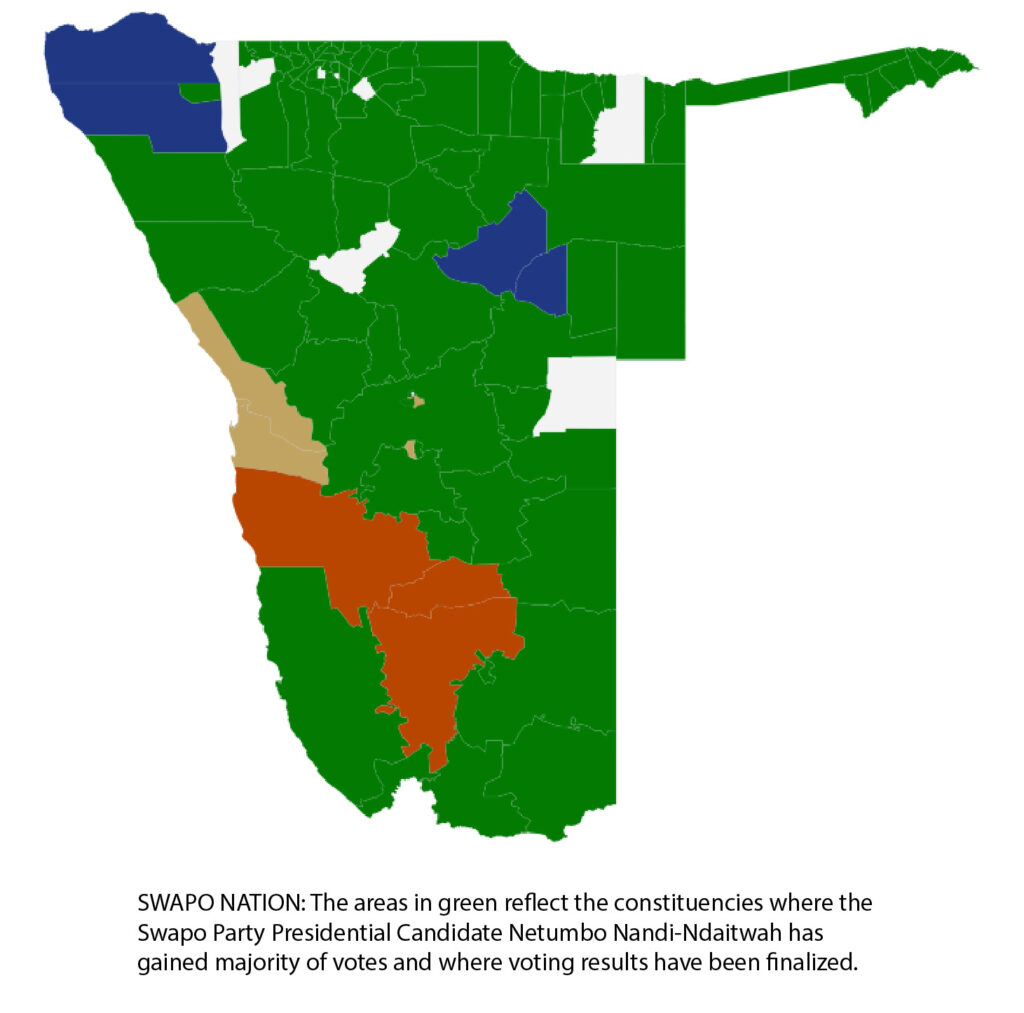
Swapo Party’s Presidential Candidate, however, leads the Presidential candidate race, by 58.10%, Dr Panduleni Itula with 25.39%, and McHenry Venaani with 5.28%
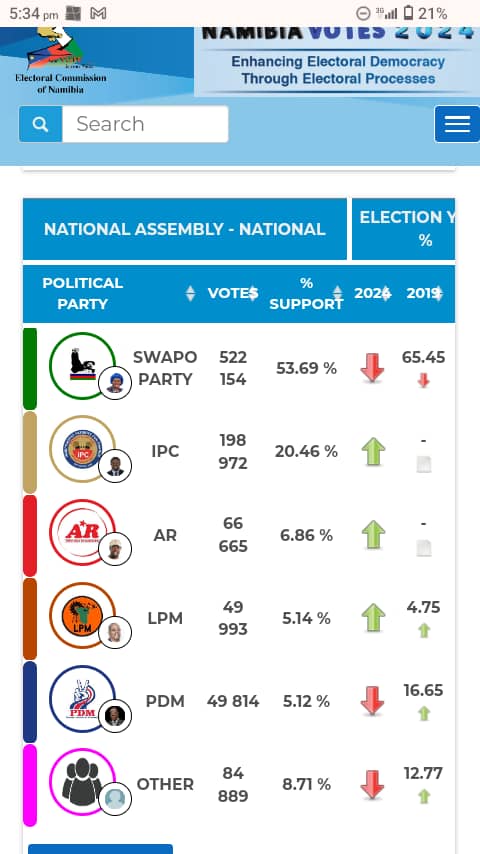
In the National Assembly ballot, the Swapo Party still remained in the front-runner position, with a total of 52.68%, Independent Patriots for Change with 20.74%, and the Affirmative Repositioning party with 6.80% for the AR.
In the Q&A session, with only nine and 10 constituency results left for both the Presidential and National Assembly results, the Chairperson of the ECN, Dr Elsie Nghikembua, said that the commission has only a few results left and would inform the media on the next announcement.
Touching on the recent threat of litigation by several opposition political parties who wish to approach courts to have the election results nullified citing irregularities such as a shortage of ballot papers and a lack of voting country wide, Dr Nghikembua said that not a single one has reached out to the ECN for that discussion. “We have regular Political Party Liaison Committee (PLC) meetings with parties; at some point, we would meet. However, for now, we have been busy. We have by-elections in some constituencies. Those are some of the pending PLC items,” the commissioner said.
Dr Nghikembua also addressed concerns that there were a total of 19,000 votes which were rejected, adding that this is a high number.
She, however, said that research should be done on what is the cause of the number of rejected ballots and that conclusions should not be made that this is due to a lack of voter education.
With the current challenges faced in the elections, such as the shortage of ballot papers, Dr Nghikembua said that it is still uncertain how the ECN would hold its future elections. “The process with ballot papers is more expensive, with regard to printing costs. The counting is also tedious, unlike with the Electronic Voter Machines (EVM), which does the tallying automatically. With EVM, there are no rejected ballots. I am not in a position to express the commission’s plan on how we are going to run future elections. It is a decision that needs thorough consideration. The history of EVMs, from conceptualisation, took about 12 years; it is not something done in a short span of time. At the moment, the position remains unclear. The EVMs that we didn’t want were quite useful; it is only the absence of the paper trail,” Dr Nghikembua said.