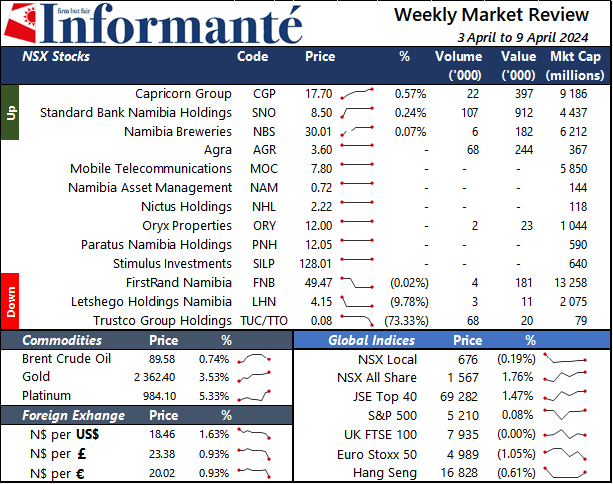
The Namibian stock market experienced a mixed performance this past week, with the benchmark NSX Local index declining marginally by 0.19% to close at 676.1, while the broader NSX Overall Index rose by a more substantial 1.76% to 1,566.5. As of April 9, 2024, FirstRand Namibia remained the largest listed company on the exchange, boasting a market capitalization of N$13.3 billion. This was followed by Capricorn Group at N$9.2 billion, Namibia Breweries at N$6.2 billion, and Mobile Telecommunications at N$5.9 billion. In terms of individual stock performance, Capricorn Group emerged as the week’s top performer, advancing 0.6% to close at N$17.70 per share. Standard Bank Namibia Holdings followed closely, gaining 0.2% to end the week at N$8.50 per share. On the trading volume front, Standard Bank Namibia Holdings led the market, with N$0.9 million worth of shares changing hands. Capricorn Group took the second spot, recording N$0.4 million in traded volume. The Namibian Dollar displayed strength against major international currencies during the week. It gained 1.63% against the US Dollar, closing at N$18.46 per USD, and appreciated 0.93% versus both the British Pound and the Euro, ending at N$23.38 per GBP and N$20.02 per EUR, respectively.
Namibia’s annual inflation rate decelerated to 4.5% in March 2024, down from 7.2% recorded in the same month of the previous year. This downward trend has been observed since January 2024, according to the latest data. On a monthly basis, the inflation rate remained unchanged at 0.0% during the period under review. The key drivers behind the annual inflation rate in March 2024 were Food and non-alcoholic beverages, which contributed 1.0 percentage point, Alcoholic beverages & tobacco, contributing 0.9 percentage points, Housing, water, electricity, gas, and other fuels, accounting for 0.8 percentage points, and Transport, which contributed 0.7 percentage points. Analyzing the inflation rates across different zones, the data reveals that Zone 2 (Khomas region) recorded the highest annual inflation at 5.1%, followed by Zone 1 (Kavango East, Kavango West, Kunene, Ohangwena, Omusati, Oshana, Oshikoto, Otjozondjupa, and Zambezi regions) which posted an inflation rate of 4.5%. Zone 3 (//Kharas, Erongo, Hardap, Omaheke regions) had the lowest annual inflation at 3.5%.