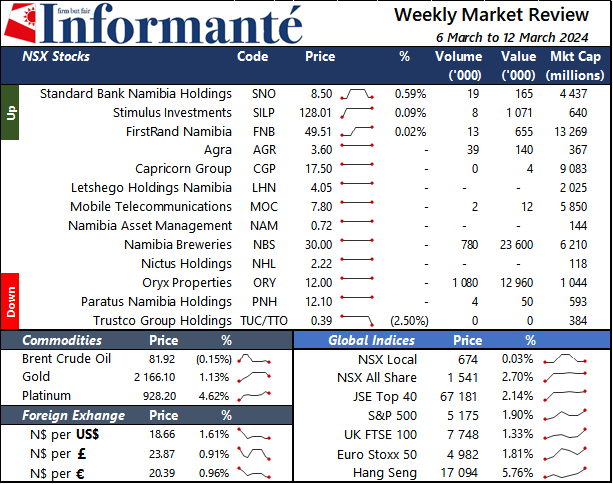
This week, the local market witnessed a marginal uptick with the NSX Local index rising by 0.03% to 673.8, while the NSX Overall Index displayed a stronger performance, surging by 2.70% to 1541. As of 12 March 2024, FirstRand Namibia emerged as the largest local entity on the exchange, boasting a market capitalization of N$ 13.3 billion. It was closely followed by Capricorn Group at N$ 9.1 billion, Namibia Breweries at N$ 6.2 billion, and Mobile Telecommunications at N$ 5.9 billion. In the weekly market performance, Standard Bank Namibia Holdings took the lead, with its shares appreciating by 0.6% to close at N$ 8.5 each. Stimulus Investments trailed behind, marking a slight increase of 0.1% to end at N$ 128.01 per share. In terms of trading volume, Namibia Breweries led the market with shares worth N$ 23.6 million being traded. Oryx Properties followed suit with a trading volume reaching N$ 13.0 million. On the currency front, the local currency made significant strides, appreciating by 1.61% against the US Dollar to close at N$ 18.66 per USD. It also gained 0.91% against the British Pound to close at N$ 23.87 per GBP, and saw a gain of 0.96% against the Euro, closing at N$ 20.39.
In February 2024, Namibia’s annual inflation rate was reported at 5.0%, a significant decrease from the 7.2% recorded in the same month of the previous year, and slightly lower than the 5.4% reported in January 2024. A regional breakdown of the inflation rates for February 2024 shows that Zone 2 (Khomas region) had the highest annual inflation rate at 5.5%. This was closely followed by Zone 1 (comprising Kavango East, Kavango West, Kunene, Ohangwena, Omusati, Oshana, Oshikoto, Otjozondjupa, and Zambezi regions) with an inflation rate of 5.3%. Zone 3 (which includes //Kharas, Erongo, Hardap, Omaheke regions) reported a lower annual inflation rate of 4.0%. The primary drivers of the annual inflation rate for February 2024 were ‘Food and non-alcoholic beverages’, contributing 1.1 percentage points to the overall inflation. This was followed by ‘Transport’ and ‘Alcoholic beverages & tobacco’, each contributing 1.0 percentage points. ‘Housing, water, electricity, gas, and other fuels’ also had a notable impact, contributing 0.9 percentage points to the inflation rate.