Staff Reporter
THE Minister of Agriculture, Water, and Land Reform, Calle Schlettwein, recently expressed concerns about the diminishing reliability of the country’s water resources and the resulting challenges in ensuring water provision for the entire population.
Schlettwein brought attention to this issue during the recent End of the Year 2023 Press Briefing led by President Hage Geingob and Cabinet Members. The purpose of this briefing was to update the public on the progress made toward national goals.
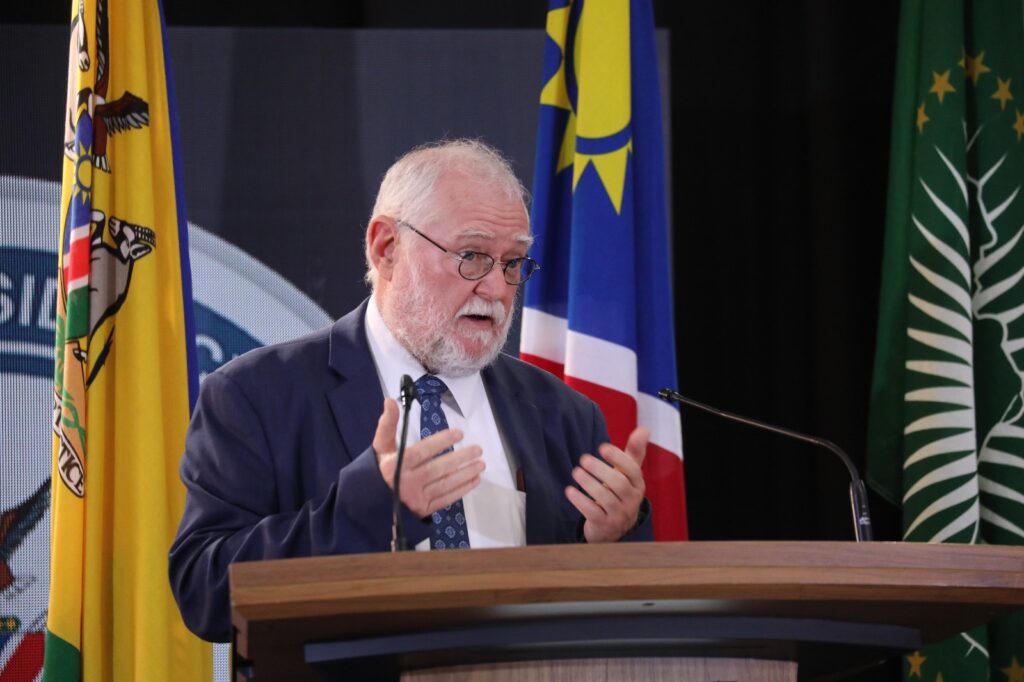
According to Schlettwein, approximately 12% to 15% of the population lacks access to water, predominantly in remote rural areas. He emphasised his ministry’s commitment to addressing the needs of these affected individuals. However, he pointed out that there are significant challenges that make it difficult, highlighting climate change as chief among these challenges.
“Our water resources that we use currently, mainly surface water – that’s dams and rivers – will become less and less reliable because of climate change. We will be more flood-prone than before. We have to rely more on groundwater, but even groundwater is relying on rain. So that source will also become less and less reliable,” he said.
Schlettwein proposed that focusing on long-term solutions, such as constructing and prioritising desalination plants, is the best approach to tackle Namibia’s water provision challenges.
“We believe that our way out of that in the long-term is desalination. We have started that. Our first desalination plant is still operating. We are building now the second one. We are close to closing the financial agreement and then we can start building it,” Schlettwein explained.
While the water sector is faced with this significant challenge, Schlettwein also revealed that the sector has also witnessed some impressive achievements. These accomplishments include the United Nations (UN) recognising President Geingob as a game-changer on the water agenda as well as the UN Educational, Scientific and Cultural Organisation (UNESCO) awarding Namibia for its ability and framework on dealing with cross-border groundwater aquifers.
“I think we have done quite a lot to bring about and to achieve our 2030 goal of potable water for all. It stands at about just below 90%. 90% of all Namibians have clean water available, provided that we agree that it is not at the house, but 2.5 kilometres walking,” Schlettwein added.