Zorena Jantze
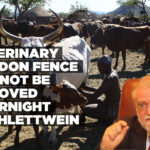
THE Minister of Agriculture, Water, and Land Reform has said that the translocation of the Veterinary Cordon Fence (VCF) from its current location or its complete removal is not a simple action that can take place overnight.
Schlettwein added that an abrupt removal of the current VCF is too dire to contemplate and will result in a plethora of negative consequences, despite the ongoing court battle to remove the fence lodged by AR leader, Job Amupanda. Schlettwein made these remarks in a court affidavit released on 24 November 2023, in which he argued for the gradual removal of the fence after implementing several animal health protective measures. The VCF cordons off about 1.2 million cattle and provides a livelihood to about 56.2% of Namibians residing in Northern Communal Areas (NCAs).

Schlettwein said that the abrupt removal of the VCF will lead to the potential outbreak and spreading of infectious animal diseases countrywide in Namibia, a contraction of growth in the agricultural sector, and its contribution to the economy of Namibia, with the concomitant loss of income and jobs. In addition to this, he added that the country will lose existing lucrative markets together with the associated benefits from trade, especially for livestock and livestock products from south of the VCF. He emphasized that Namibia is the only country on the African Continent that has market access for beef, lamb, and mutton to markets in the European Union, the United States of America, China, Ghana, the United Arab Emirates, etc., because Namibia’s animal health status and measures to maintain them are accepted as equivalent and up to the standard of the World Organisation for Animal Health (WOAH).
To shield the NCA areas from the negative effects of the VCF, Schlettwein said that the Namibian government is spending annually about N$150 million on the vaccination of the whole cattle population of approximately 1.2 million head of cattle in the NCA, boosting herd immunity and protecting the animal health of cattle stock in those areas, which is a prerequisite for trade in and human consumption of beef and beef products produced in the NCA.
He added that this is in line with a resolution taken at the second land conference.
To further achieve the ultimate goal of making Namibia FMD free without vaccination, Schlettwein said that the government needs to achieve and maintain animal health at all times and gradually shift the VCF north to protect existing infectious animal disease-free zones and expand them over time. In addition to this, he added that the government is collaborating with its neighbouring countries to coordinate a cross-border vaccination plan of action for cattle stocks and the control of movements of African Buffaloes to eliminate future outbreaks and spreading of infectious animal diseases, such as FMD and lung sickness, and to achieve cattle stocks free of these diseases across shared borders. He added that there is also a need to invest in supporting infrastructure, e.g., feedlots and abattoirs in the NCA.
“Despite the progress that has been made to reduce the negative consequences of the VCF as described, there is still a long way to go to achieve the ultimate goal of systematically translocating the VCF to include the NCA in the whole area of Namibia that is free of FMD without vaccination,” Schlettwein said. He added that the NCA was almost recognized as an FMD-free zone without vaccination for 24 months in 2014; however, it suffered an FMD outbreak in 2015. “It is this current export trade regime, and the remaining time required to achieve the status of a free zone for the NCA, which perpetuates the barrier between the animal disease-free and the animal disease-infected areas as described. Due to the complexity of the interrelated actions that still need to be completed to achieve animal disease-free status for the whole of Namibia, the shifting of the VCF has to be executed gradually,” the minister stressed.