
Staff Reporter
PERIOD poverty accounts for the high rate of school absenteeism among Namibian girls and therefore has a profound impact on the quality of education in the country.
This was highlighted by the Minister of Presidential Affairs, Christine //Hoebes, at the handover of 260 boxes of sanitary pads to Regional Governors from the Khomas, Hardap, Erongo, Otjozondjupa and Omaheke regions.
The sanitary pads were donated by the National Diagnostic Laboratory, which is a pathology laboratory that operates in the private healthcare environment.
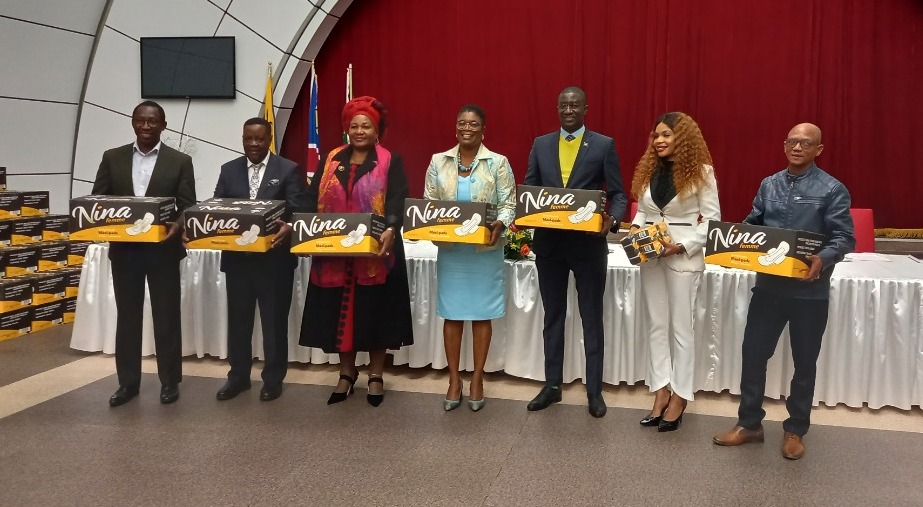
The boxes, which equates to 100 000 sanitary pads, will be distributed among the regions, with each receiving a total of 864 sanitary pads for further distribution to identified schools across the country.
“We believe that in this day and age, no single girl should miss school simply because of a lack of sanitary pads or lack of menstrual hygiene. It is this realisation that motivated our organisation, National Diagnostic Laboratory, to hand over this modest donation of 100 000 sanitary pads for school-going girls in Namibia,” the Chief Executive Officer (CEO) of National Diagnostic Laboratory, Maria Hembeleleni Matsi, said.
//Hoebes acknowledged that the 260 boxes might not address the national sanitary poverty. However, she added that she hopes that the gesture will emphasise the importance of a unified front in addressing negative issues arising from menstruation.
“The topic of menstruation is considered by many as a taboo, and has many negative cultural attitudes associated with it, including that menstruating women and girls are ‘contaminated, dirty and impure’ while girls in rural areas suffer stigma much more,” //Hoebes explained.
She further emphasised that the provision of menstrual hygiene materials, safe water, sanitation, good hygiene, latrines and places to change is critical in learning environments and said that “without these, the school environment is unhealthy, gender discriminatory and inadequate”.
According to //Hoebes, facilitating the handover of the sanitary pads is not the government’s first or only effort to address period poverty in the country. She explained that the government has crafted many initiatives to change imbalances related to menstrual hygiene and as such the motion for tax exemption on sanitary pads was made a reality after it was tabled by the Deputy Minister of Information, Communication and Technology, Emma Theofelus.
“By making this motion a reality, Finance Minister Iipumbu Shiimi announced shortly thereafter that value-added tax on sanitary pads would be abolished to take effect in the 2022/23 financial year,” she added.
//Hoebes further assured that the government will continue to support interventions that are aimed at creating a society that is just, fair and free to ensure that all citizens are treated equally and without discrimination.