
Business Reporter
THE Bank of Namibia (BoN) has responded to the poor rating given to its governor, Johannes !Gawaxab, as listed in the latest edition of the Global Finance Central Banker Report Cards.
Global Finance, with input from analysts, economists and financial industry sources, grades the world’s leading central bankers on a scale of A to F, with A being the highest grade and F the lowest, based on a series of objective and subjective metrics, including the appropriate implementation of monetary policy for the economic conditions of each country.
The BoN governor was rated +D.
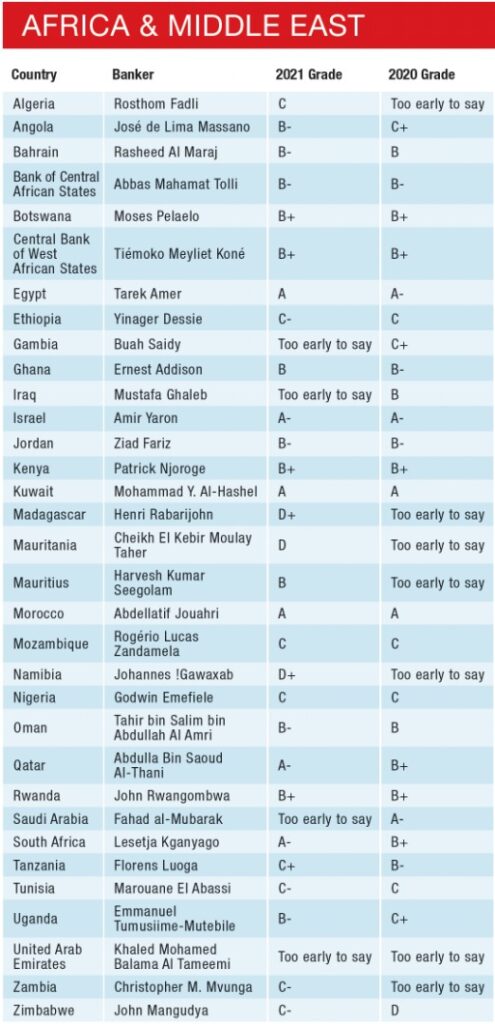

In response, BoN spokesperson Kazembire Zemburuka said the bank has noted with grave concern the inconsistency in the rating and subsequent reports stemming from the subjectivity of the interpretations of the ratings.
In the Global Finance review of !Gawaxab, it is stated that more than a year after he took over as governor, he continues to adopt a cautious approach in monetary policy.
The report further shared that in August, the BoN kept the repo rate unchanged at 3.75%, terming it appropriate in supporting the weak domestic economy and safeguarding the one-to-one link between the Namibian Dollar and the South African Rand.
“For Namibia, Covid-19 has had extensive advance impacts, prompting the central bank to warn against in June when the country experienced the third wave of infections.
“Key sectors of the economy like tourism, mining, agriculture, manufacturing and construction have been badly ravaged. The ripple effects have been significant decline in banking industry profits and surge in NPLs.
“Concerns over the stability of the industry have forced the BoN to heightened credit risk monitoring and carry out stress tests. The weak economy has forced the BoN to revise its economic growth projections to 1.4% from an earlier forecast of 2.7%,” it was said in the report.
Zemburuka said these reports and the conclusions thereof appear fundamentally flawed, arguing that an attempt to correlate the actions of the central bank and the performance of the governor to the overall macroeconomic conditions in the country is inaccurate and highly misleading, as the bank is restricted to its role of ensuring monetary and financial stability.
Also, to the contrary, it is a common cause that Namibia’s macroeconomic stability has been tested during the preceding two years due to the Covid-19 pandemic, Zemburuka said.
“During such difficult economic times, confidence tends to be affected negatively. Notwithstanding the unprecedented shocks on the economy and financial institutions, Namibia has emerged relatively resilient thanks to the prompt measures undertaken by key stakeholders, including the Bank of Namibia.
“These measures were taken to maintain credit flow and to ensure that the domestic market was liquid – conditions essential in averting a crisis and a deeper recession,” Zemburuka stated.
He said the deterioration of general confidence induced by Covid-19 has continued to undermine the effectiveness of the central banks’ measures amid the already-low credit uptake, which further negatively affected consumption and investment which are key elements for economic recovery.
“It is worth reminding that the two key responsibilities of the Bank of Namibia are to ensure monetary stability and financial stability. Namibia’s inflation and policy rates are at historic lows, and we continue to support individual households and businesses to weather the pandemic-induced storm.
“We have a stable, modern, and sound financial system despite serious challenges introduced by Covid-19. Banks remain profitable and well-capitalised, payments and settlements continue uninterruptedly, and so does credit provisioning.
“We continue to work closely with government and private sector agencies to ensure economic recovery and sustainable economic development going forward,” Zemburuka said.