Staff Reporter
DELIVERING the State of the Nation Address, President Hage Gaingob stated that 70% of developmental goals set out in his Harambee Prosperity Plan were achieved.
Geingob delivered the SONA amidst the pressing COVID-19 pandemic which he states has elevated government’s debt stock to above 60%.
“Unfortunately we are caught up in unsustainable debt we have to do something to reduce it. First it was the economic downturn, then drought, now we have to spend on COVID-19.” Geingob stated.
The president stated that the 70% overall execution rate on set goals and outcome has been calculated against the implementation outcomes of activities per pillar.
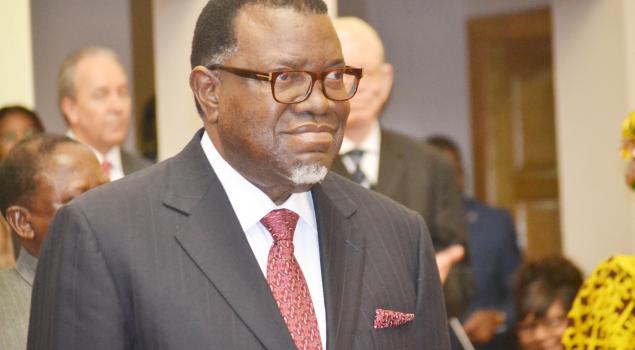
“Despite a number of independent intervening variables that adversely affected our ability to obtain the set target of an 80% execution rate, we achieved this relatively high rate by focusing on key deliverables with lesser financial implications.” Geingob stated.
He exemplified that decisions such as cancelling the awarding of the Hosea Kutako International Airport upgrading tender, which was inflated from 3 to 7 billion Namibian Dollars were among the key successes in the financial pillar. He added that the country’s flagship Airline, Air Namibia is currently not making any profits and is constantly being bailed out and urgent measures need to be taken to address this situation.
“We will only prevail in the war against corruption, when transparency is nurtured within governance systems. Namibia increased in ranking on the Ibrahim Index, making us one of the top five best-governed countries in Africa. Namibia is 4th on the continent preceded by Mauritius, Seychelles and Cabo Verde in the top three positions.” Geingob cited.
The president further noted that the Namibian economy has continued to experience unprecedented headwinds, since 2016. The challenges included are declining economic growth and per capita income, low investments and a high public expenditure ratio, compounded by the global economic downturn, declining commodity prices and exchange rate fluctuations.
“The five-year drought that ravaged our agricultural sector, exposed thousands of Namibian households to food insecurity, necessitating the reallocation of funding to the Drought Relief Programme, in line with our commitment that no Namibian should die due to Hunger.” Geingob said.
He added that to stabilize public finances, a fiscal consolidation strategy and expenditure prioritization was introduced in 2015. Geingob stated that unfortunately these prospects have been severely compromised by the outbreak of COVID-19.
Geingob further highlighted that he reduced Government structure from 25 Ministries down to 19 Ministries. “We achieved this reduction of six Ministries by merging some of the existing ones, to align government functions for efficient and effective service delivery. In line with the SWAPO Party’s commitment to reaching gender parity at the highest levels of government leadership, 18 of the 29 newly appointed Ministers and Deputy Ministers are women. This represents 62 percent female representation in the Executive.” Geingob said.
Touching on housing in the country, Geingob stated that the delivery of residential even was achieved at 89% or 23,194 plots of the targeted 26,000.
He however added that the national housing backlog remains above 300,000 units.
“I am conscious that despite these achievements and considering the persistently high national demand, we need to accelerate our efforts in the area of housing and land provision, particularly in major cities and towns.” Geingob stressed.
He added that since the declaration of a Humanitarian Crisis in informal settlements, a pilot project has commenced in Windhoek, to transform peri-urban settlements into sustainable human settlements that are planned, serviced and occupied through various tenure options.
Geingob further stated that Unemployment remains high at 33% in 2018, while youth unemployment increased to 46.% during the same period.
“The status quo is not sustainable and emphasis falls on stimulating job-generating economic growth. The NSA also reports that the Namibian economy created 48,857 jobs between 2016 and 2018. Regrettably, recurring drought spells and declining consumer spending negatively reversed these gain.” Geingob stated.
He however added that SME development recorded satisfactory improvements over the term. Following the closure of the SME Bank, Government through the Development Bank of Namibia established SME Centers in three regions, to respond to SME funding needs.
“The Development Bank of Namibia approved a total of 425 million Namibian Dollars for SME projects between 2017 and 2020, benefitting 318 SMEs. To address the hurdle of non-collateralized lending, Government introduced the Skills Based Lending facility; the Credit Guarantee Scheme; Mentorship Programmes and facilitated the establishment of one hundred and twenty one rural youth enterprises. All these programmes were capitalized with an amount of 130 million Namibian Dollars.” Geingob highlighted.
He further stressed that economic transformation agenda remains urgent and can be realized through structural reforms that support inclusion of the previously disadvantaged majority, and diversification of economic activities through industrialization and manufacturing.,
Geingob informed that Government received this week a report from the Economic Policy Research Association on the latest version of NEEEB.
“A cursory review suggests that the authors are interested only in protecting the interests of well-established businesses and a select few. Typically what is referred to as placing ‘Profit before People’. It is regrettable that some Namibians are not willing to hold hands, to preserve the future of our country. Namibia remains among the most unequal societies in the world, confirming the deeply embedded structural nature of our challenge.” Geingob said.
According to Namibia Statistics Agency, poverty declined in Namibia from 70 percent in 1994, to 37.7 percent in 2003 and 18 percent by 2016. According to the 2017 World Bank Report and as endorsed by Oxfam International, Namibia’s decline in poverty is attributable to a targeted policy framework. Government allocates a high percentage of resources to the social sectors, including universal access to education, a highly subsidized healthcare system and Social Safety Nets that reverse the effects of a skewed economy.
In total, Government spends 3.9 billion Namibian Dollars on social 14 grants per annum, benefiting 1 million people or 41 percent of the total population.
Over the period 2015 to 2019, Government redirected resources to the value of 2.1 billion Namibian Dollars towards the drought relief programme, which has benefitted annually, an average of 564,983 people across all 14 regions.