Growth Surprises at 4.8%, but Not From Mining
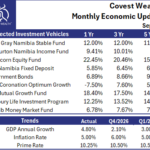
The Q2 print has arrived and it overturns last month’s story. Real GDP grew 4.8% year-on-year in the second quarter, up from 1.7% a year earlier, and Q1 was revised up to 3.1%. Services expanded 6.1%, agriculture 17.8% on good rains, and wholesale and retail trade 9%. Mining contracted 3.1%, with uranium down 12.0%, and exports grew only 0.3% against import growth of 12.9%. The Bank of Namibia’s 2.1% forecast for 2026 now looks conservative. “We said in August that the recovery was losing altitude, and the data has corrected us,” says Pieter De Klerk, CEO of Covest Wealth. “But look at what grew: rain, retail and a weak base. Mining shrank again and exports stood still. Growth built on consumption and good weather has to be earned again every quarter.”
Inflation Breaks 5%; the SARB Moves First
Headline inflation rose to 5.0% in August from 4.4% in July, with prices up 0.6% on the month, the highest reading since February 2024. Transport inflation reached 13.2% and contributed 2.0 percentage points of the total. Food inflation stood at 4.0%, down from 5.2% a year earlier, and core inflation at 3.8%. On 23 September the South African Reserve Bank unanimously raised its policy rate by 25 basis points to 7.25%. Namibia’s repo rate remains at 6.75% and prime at 10.25%. “The plateau lasted one month,” says De Klerk. “Core at 3.8% still says this is a fuel story, not a demand story, but the Bank’s 4.0% forecast for the year is now out of reach. With the SARB at 7.25%, our repo rate sits 50 basis points below the anchor. At the 26–27 October meeting, a hold is the decision that would need explaining.”
Fuel: Pressure Still Building
September’s increase left petrol at N$25.08 at Walvis Bay and diesel at N$27.86 and N$27.96, and none of it is yet in the inflation numbers. The October review had not been announced at the time of writing, but the direction is not in doubt: Brent crude is above US$100 a barrel, and South Africa is on course for increases of around R3 per liter on both petrol and diesel from 7 October. On supply, a TotalEnergies-led group replaces Vitol from November at an average discount of 63.85 cents per liter. “A competitive tender and a discount are the right way to buy fuel, and government deserves credit for that,” says De Klerk. “But 64 cents does not offset oil above US$100. The question for October is how much of the gap the National Energy Fund absorbs and how much reaches the pump.”
Credit Slips to 4.2% as Corporates Repay
Private sector credit growth slowed to 4.2% year-on-year in July from 4.5% in June, and the loan book fell by N$340 million to N$125.1 billion, the first monthly contraction since October 2025. The weakness was corporate: business credit declined by N$778.7 million and annual growth eased to 3.7% from 4.5%. Household credit growth edged up to 4.6%, with household mortgage growth at 2.4%, the fastest since December 2023, while overdraft growth cooled to 8.9% from 12.5%. In real terms, private sector credit contracted by 0.2%. “Households are still borrowing for houses and leaning less on overdrafts, which is the right mix,” says De Klerk. “Corporates are doing the opposite of what a 4.8% economy would suggest: repaying, not investing. Credit growing slower than prices is an economy that is cautious, not one that is overheating.”
Trade Gap Widens Further; Reserves Hold at N$58 Billion
The trade deficit widened to N$5.9 billion in July as exports fell 17.2% on the month to N$10.7 billion against imports of N$16.5 billion; a year earlier the account showed a small surplus. Imports eased 9.7% from June’s record but were 31.5% higher than in July 2025, and petroleum oils alone accounted for N$2.2 billion of the deficit. International reserves nonetheless rose 2.9% to N$58.0 billion at end-July, 3.6 months of import cover, on SACU receipts and foreign currency placements by commercial banks. “Last month it was record imports; this month exports fell N$2 billion as well,” says De Klerk. “Reserves at N$58 billion mean the peg is not in question, but SACU receipts are doing the work that exports should be doing. That is a cushion, not a strategy.”
Conclusion
“September delivered a growth surprise and an inflation surprise in the same month,” says De Klerk. “The arithmetic has tightened: prime at 10.25% against inflation at 5.0% is a gap of just over five percentage points, down from nearly six a month ago. Yields remain well ahead of inflation, but the margin is no longer widening. The response to a month like this is not to chase or retreat, but to review whether a portfolio still fits the investor’s own time horizon. That conversation is best had with an adviser.”