Staff Reporter
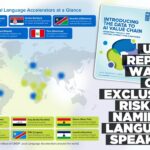
NAMIBIA is among 11 countries highlighted in a United Nations Development Programme (UNDP) initiative aimed at developing artificial intelligence tools for underrepresented languages, with the organisation warning that languages such as Kwangali and Kuanyama remain severely disadvantaged in the global AI ecosystem.
The findings are contained in the Introducing the Data-to-AI Value Chain report, jointly published by UNDP and Current AI, which examines how gaps in data, infrastructure, investment and governance can prevent local-language AI projects from progressing beyond pilot stages.
As part of the Local Language Accelerator (LLA) initiative, UNDP is working in Namibia to develop local-language datasets and AI applications for agriculture, with Otjiherero identified as the primary language for the country’s pilot.
The initiative aims to develop practical tools, including agricultural advisory services, that can provide information to farmers in their own language.
The report highlights the disparity in AI model development between well-resourced and under-resourced languages. While English receives up to 50 000 new AI models annually, Kwangali and Kuanyama average only 4.15 new models per year.
According to the report, the imbalance risks excluding speakers of underrepresented languages from economic, educational and public services that increasingly rely on digital technologies.
The report also identifies a less visible economic barrier: tokenisation. AI systems break text into tokens when processing language, and models designed primarily around English can require significantly more tokens to process the same content in under-resourced African languages.
This can increase the computational and API costs associated with developing and operating AI applications in those languages, creating an additional barrier for local developers and businesses.
UNDP and Current AI propose the “Every Language Matters” (ELM) initiative to address these challenges through a five-stage Data-to-AI Value Chain covering data collection, data curation, model training, deployment, and impact and reuse.
The framework is intended to prevent local-language projects from ending when initial grant funding expires, with the report highlighting the need for sustained investment in shared infrastructure, deployment and institutional ownership.
The report also calls for stronger data sovereignty and community participation, including Free, Prior and Informed Consent (FPIC) for publicly funded language data collection and community-centred licensing mechanisms.
These measures are intended to ensure that community-generated data and traditional knowledge are not extracted for commercial AI systems without meaningful participation and benefits for the communities concerned.
The report places Namibia’s experience within a wider African context, noting that an analysis of 884 African-language AI research papers found that more than 70% of African languages appeared in fewer than five papers.
Research and development remain concentrated around a relatively small number of languages, including Swahili, Hausa, Yoruba and Amharic.
The report identifies several measures governments could take to strengthen local-language AI ecosystems, including auditing and opening existing public data resources such as broadcasting archives, parliamentary records and educational materials under appropriate open licences.
It also highlights public procurement as a potential driver of local AI development, arguing that requiring local-language capabilities in government technology procurement could create demand for domestic developers and technology companies.
For Namibia, the report indicates that the long-term value of the Otjiherero agritech initiative will depend not only on developing datasets and AI models, but also on sustained deployment, institutional support and the integration of local-language technologies into public and economic services.
Source: Introducing the Data to AI Value Chain Report by UNDP, and Current AI