
Staff Reporter
//KHARAS Governor Dawid Gertze has called on parents, schools, traditional leaders and communities to strengthen child protection and create safe homes, schools and communities where children can learn, grow and develop without violence, abuse or trauma.
Speaking during the Day of the Namibian Child celebrations in Oranjemund, Gertze said protecting children was a shared responsibility that required cooperation between families, schools, communities, law enforcement, social workers, traditional leaders and civil society.
He said Namibia had made progress in protecting and promoting children’s rights through legislation, policies, social protection programmes and expanded access to education, but warned that these measures would only be meaningful if children experienced safety in their daily lives.
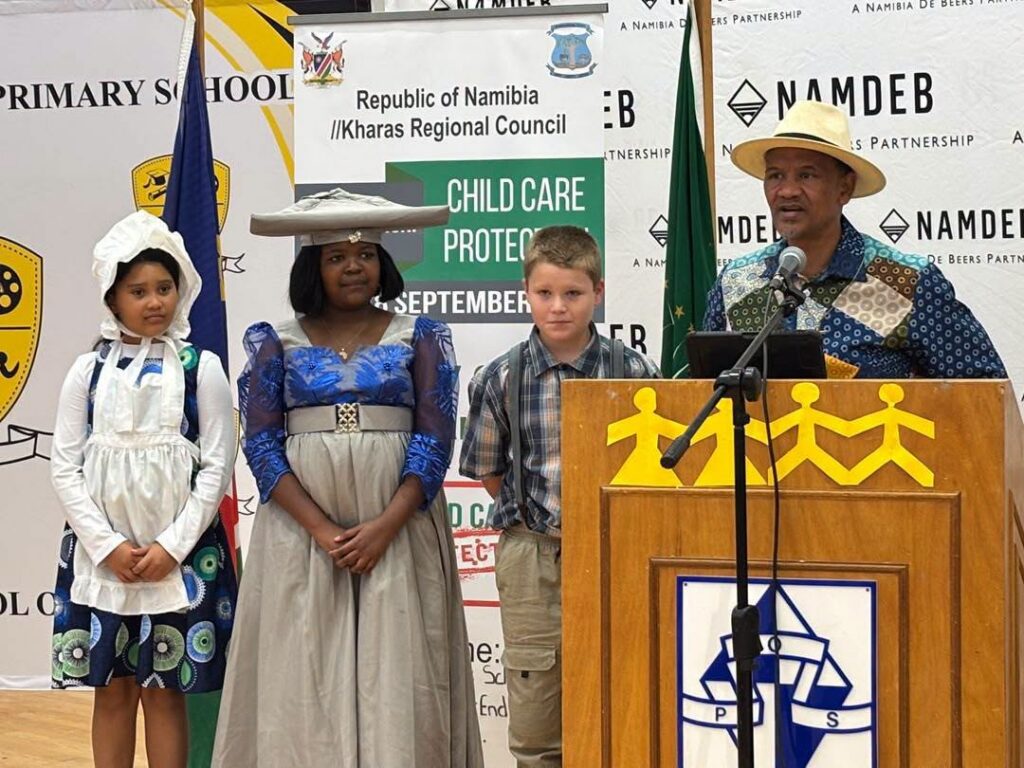
Photo: MICT Kharas Regional Office
“A child cannot fully enjoy the right to education if that child is afraid at home or at school,” Gertze said.
He said the theme of the commemoration, “Safe Homes, Safe Schools, Safe Communities: End Violence Against Children in Namibia”, should serve as a call to action against violence, abuse, neglect and other forms of harm affecting children.
Gertze said child protection must begin at home, with parents, guardians and extended families taking responsibility for the safety and emotional wellbeing of children.
He called for a return to positive cultural values in which the wellbeing of every child was regarded as a shared responsibility, saying children should be guided, taught, redirected and supported by the wider community.
“Every child in the community is everyone’s responsibility,” he said.
Gertze also emphasised that children must respect and protect the dignity of their teachers, while teachers must ensure that schools remain safe spaces for learners.
He said bullying, corporal punishment, substance abuse and predatory behaviour had no place in schools, while warning that the involvement of adults in supplying drugs to children at schools was a wider societal problem.
“Schools ought to be a safe space,” he said, adding that homes and schools could not operate in isolation and required strong links with communities.
Gertze said local authorities, the Namibian Police Force, social workers, traditional leaders and civil society all had a role to play in strengthening these links and protecting children.
He also highlighted the importance of culture in providing children with values, guidance and a sense of belonging, saying cultural values should remain part of everyday life.
According to Gertze, education remains one of the strongest tools for breaking cycles of poverty, exclusion and vulnerability, and children should make use of available educational opportunities.
He encouraged young people to remain committed to their studies, develop digital literacy, technical skills and critical thinking, and seek guidance from teachers and trusted adults.
He further called for investment in youth facilities, extracurricular programmes and psychological support services to address the broader wellbeing of children.
Gertze said children should understand that rules and regulations imposed by parents and other adults were intended to protect them and prepare them for the future.
“The fact that we inconvenience you at home by applying rules does not mean that we do not love you,” he said.
Addressing parents and adults, Gertze urged them to leave the celebrations with a renewed commitment to protecting children at home, at school and within their communities.
He said the wellbeing of children was a national priority, noting that children aged between zero and 17 accounted for approximately 42.7% of Namibia’s population, or about 1.3 million people, according to the 2023 census.
Gertze concluded by calling on communities across //Kharas to work collectively towards safe homes, safe schools and safe communities, and to bring violence against children to an end.