Staff Reporter
THE United States has reaffirmed its support for Namibia’s efforts to combat wildlife trafficking, highlighting the country’s first Environmental Crimes Court in Otjiwarongo as an important institution in tackling transnational organised crime.
U.S. Ambassador to Namibia John Giordano said wildlife trafficking extends beyond conservation and is linked to criminal networks involved in the trafficking of narcotics, weapons and people.
Giordano made the remarks after visiting the Environmental Crimes Court in Otjiwarongo, as the court marked its second anniversary.
“Wildlife trafficking is not simply a conservation issue. It is a transnational crime,” he said.
He said protecting Namibia’s natural heritage requires effective law enforcement, capable institutions, international cooperation and consequences for those involved in the illegal wildlife trade.
Since its inauguration in August 2024, the Environmental Crimes Court has heard 50 wildlife crime cases, with 47 resulting in convictions, according to Giordano.
The cases have involved the illegal trafficking of rhino horn, pangolin scales, elephant tusks and other wildlife products.
Giordano said the court demonstrated Namibia’s commitment to building institutions and capacity to combat wildlife crime.
“The Court is not simply a place where cases are heard. It is a statement – that Namibia’s natural heritage is not for sale to criminal networks,” he said.
He said the prosecution of wildlife trafficking cases requires specialised expertise in areas including forensic investigations, cross-border intelligence and the criminal networks and supply chains used to move illegal wildlife products from protected areas to international markets.
The United States has supported the establishment and development of the court.
Through the U.S. Department of State’s Bureau of International Narcotics and Law Enforcement Affairs, the United States contributed more than N$2.5 million towards the construction of the court and provided specialised training for prosecutors handling wildlife crime cases.
Giordano said this support forms part of a broader U.S.-Namibian law enforcement partnership dating back to 2016.
According to him, a US$19 million U.S. initiative has been used to strengthen law enforcement cooperation between the two countries in combating wildlife trafficking.
The initiative also supported the establishment of the Wood Identification Screening Centre in Windhoek, which Giordano described as the only facility of its kind in Africa and which assists authorities in identifying and prosecuting timber trafficking.
The initiative has further supported customs and border security, improved access to information for prosecutors and strengthened cooperation between Namibian, regional and U.S. law enforcement officials.
Giordano said the fight against wildlife trafficking was ultimately about people and institutions, rather than buildings and equipment.
He described the Environmental Crimes Court as part of a broader Namibian conservation model involving government, law enforcement agencies, conservationists and private landowners.
He said this approach helps protect Namibia’s natural heritage and the tourism economy that depends on it.
“Wildlife trafficking does not respect borders, and neither can the response to it,” Giordano said.
He said the United States, Namibia and countries across the region had worked together for more than a decade to strengthen international law enforcement cooperation, build institutions capable of delivering justice and ensure that criminal networks have no safe haven.
“Namibia is a global leader in conservation. Working together, we can safeguard its extraordinary natural heritage and disrupt the transnational criminal networks that threaten it,” he said.
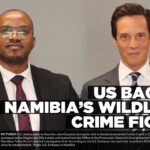
PICTURED: U.S. Ambassador to Namibia John Giordano during his visit to the Environmental Crimes Court in Otjiwarongo, accompanied by Magistrate Billy Lutaka and teams from the Office of the Prosecutor-General’s Environmental Crimes Unit and the Namibian Police Force’s Special Investigative Unit. According to the U.S. Embassy, the court has recorded a 96% conviction rate since its establishment. Photo: U.S. Embassy in Namibia