Staff Reporter
SEVERAL key water infrastructure projects are planned for the Oshikoto Region, with the Environmental Investment Fund (EIF) allocating N$6.4 million for their implementation.
This was announced by the Ministry of Agriculture, Fisheries, Water and Land Reform, which said construction is expected to commence before the end of July 2026.
According to the ministry, the projects will include the drilling and installation of new boreholes, cleaning of existing boreholes, rehabilitation of pipelines, installation of booster pumps, construction of new earth dams, removal of borehole equipment and piping, upgrading of wells, development of bulk water pipelines, as well as a proposed desalination plant aimed at improving access to potable water.
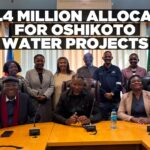
These projects were discussed when the Executive Director and Accounting Officer Vote 38 of the Ministry of Agriculture, Fisheries, Water and Land Reform, Teofelus Nghitila, and a team from the Directorate of Rural Water Supply and Sanitation, conducted a courtesy visit to the Governor of the Oshikoto Region, Sacky Kathindi, and the Acting Chief Regional Officer of Oshikoto Region, Petrus Ndawedwa.
The ministry said the visit formed part of ongoing efforts to address water scarcity in the region and was also part of Nghitila’s official regional tour of Oshikoto and Ohangwena from 23 to 26 June 2026.
With regard to the anticipated water projects, Akaonde Village was highlighted as one of six critical hotspot areas requiring urgent attention before the end of July 2026. The governor confirmed the region’s readiness to provide the necessary quotations and cost estimates for the planned works.
Kathindi also highlighted the regional council’s commitment to addressing water challenges during his State of the Region Address (SORA), which followed the meeting with officials from the Ministry of Agriculture, Fisheries, Water and Land Reform.
During the address, the governor revealed that the construction of earth dams and traditional wells had been identified as a key initiative to be implemented through cash-for-work and food-for-work programmes, thereby strengthening local water infrastructure while creating temporary employment opportunities in the region.
He also announced that the rehabilitation of the Oshigambo Canal Project would be prioritised.
“I also wish to inform the region that the Office of the Prime Minister, working in close collaboration with the Office of the Governor and other relevant stakeholders, is actively pursuing the revival of the Oshigambo Canal Project. The successful rehabilitation and operationalisation of this strategic infrastructure will significantly enhance water availability, strengthen agricultural production and contribute to long-term socio-economic development in the region,” Kathindi said.
He further announced plans to construct boreholes at Oshivelo to boost water supply to Oshivelo, King Kaluma and surrounding communities.
“As we continue implementing these interventions, I remain convinced that, through strong partnership between government, the private sector, development partners, traditional authorities and our communities, we will overcome the water challenge confronting our region and lay a solid foundation for sustainable development and shared prosperity. To strengthen water security in the southern part of the region, NamWater has identified two boreholes at Oshivelo for development, with a contractor already appointed to commence the required work. Upon completion, the boreholes are expected to boost the existing water supply system and improve access to potable water for residents of Oshivelo, King Kaluma and surrounding communities, thereby contributing to a more reliable and sustainable water supply in the area,” Kathindi continued.
Photo: Ministry of Agriculture, Fisheries, Water and Land Reform