Economy Ends 2025 More Weakly Than Expected, But Recovery Is Building
Namibia’s economy grew by just 1.7 percent in 2025, according to the IMF’s assessment following its Article IV mission to Windhoek earlier this month — even softer than the 2.9 percent the government had projected in the February budget. “Weak diamond demand and a livestock sector still recovering from the 2024 drought were the main drags,” says Pieter De Klerk, CEO of Covest Wealth. “But 2026 is shaping up differently. Better rains have boosted agriculture, uranium exports are strong, and new investment in offshore oil is starting to flow.”
Inflation Hit a Five-Year Low in February — But Enjoy It While It Lasts
The cost of living eased faster than almost anyone predicted. Namibia’s inflation rate fell to just 2.4 percent in February 2026 — the fourth consecutive month of slowing price growth and the lowest reading since December 2020. Food prices rose by only 1.6 percent over the past year and transport costs actually fell by 1.0 percent. “February’s number is likely the low point for this cycle,” warns De Klerk. “The US and Israel launched strikes on Iran on 1 March, which has disrupted shipping through the Strait of Hormuz and sent oil prices up sharply. The IMF warned just this week that sustained higher energy prices will feed into transport, goods, and food costs worldwide — and Namibia, as a net importer of fuel, will not be immune. The conflict has already made central banks globally more cautious about cutting rates, and the Bank of Namibia will be watching developments closely before its next move.”
Lending Remains Cautious, Especially for Households
Total private sector credit grew 4.4 percent in 2025, a modest improvement on the prior year but still largely driven by businesses rather than individuals. “Corporate borrowing is doing the heavy lifting — businesses are borrowing to invest and expand,” explains De Klerk. “But individual mortgage growth is essentially flat, and people are actively paying down their overdrafts rather than taking on new debt. Households are being careful, and that caution is understandable given where interest rates have been.” Vehicle sales remain a bright spot, with 2025 delivering the strongest year for new car purchases since 2015. The IMF noted that non-performing loans have moderated to 4.3 percent, a sign that the banking system remains healthy despite the subdued credit environment.
Namibia Posts Its First Trade Surplus in January — and Mines May Benefit from the Crisis
The external trade picture improved further in early 2026. Namibia recorded a trade surplus of N$193 million in January — a turnaround from the N$391 million deficit in December. Total exports reached N$11.4 billion, with fish emerging as the top non-mineral export at N$1.3 billion, and food products as a whole generating a surplus of N$1.2 billion. “It is not just about mines anymore — fish, fruit, and agricultural products are increasingly pulling their weight,” notes De Klerk. “And while higher oil prices are bad news at the fuel pump, they tend to support uranium prices too, as the world looks harder at nuclear energy as an alternative. Namibia is the world’s third-largest uranium producer, so there is a silver lining here for export revenues.” Foreign reserves stood at 3.5 months of import cover at end-2025, providing a useful buffer against external shocks.
Conclusion
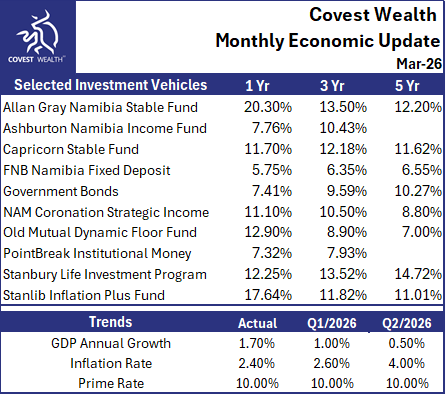
“February’s inflation number of 2.4 percent was genuinely good news — the best reading in over five years,” concludes De Klerk. “The outlook from here is less certain, with the Middle East conflict adding real upward pressure to fuel and goods prices in the months ahead. But for those who have stayed disciplined with their savings and investments, the current environment still rewards patience — and as you can see in the table alongside this article, there are still plenty of options delivering returns well above even a higher inflation rate. Building wealth through uncertainty is exactly what good financial planning is designed for.”