


Staff Reporter
THE Ministry of Health and Social Services has officially launched the first round of the National Polio Campaign.
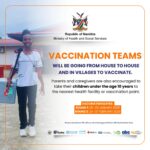
This initial phase, which began on 26 January, will run until 29 January 2026. The second phase will follow from 24 to 27 February 2026.
Dr Esperance Luvindao, the Minister of Health, announced that vaccination teams have been deployed nationwide to carry out door-to-door visits, village outreach, and provide vaccinations at health facilities, schools, kindergartens, private clinics, markets, and other public spaces.
She emphasised that there have been no confirmed cases of polio in Namibia. Nonetheless, she stressed that the campaign is crucial to act swiftly and prevent potential outbreaks before they occur.
“Namibia has been polio-free since 2006. This remarkable achievement reflects strong political leadership, a dedicated healthcare workforce, committed partners, and responsible parents and caregivers who have consistently supported immunisation efforts over the years. It stands as clear evidence that when we work together, we succeed. However, on 13 November 2025, poliovirus type 2 was detected through routine environmental surveillance in a sewage sample collected at Ndama in Rundu, Kavango East Region. Let me be very clear: there is no confirmed case of polio in Namibia. This detection serves as an early warning signal, not a cause for alarm. Environmental surveillance enables us to act swiftly and proactively before children are paralysed, before families are affected, and before an outbreak occurs,” the Minister said.
Luvindao explained that the campaign targets all children under the age of ten, as they are most vulnerable to infection and transmission, particularly of poliovirus type 2.
“Many children in this age group were born after routine vaccination against type 2 was discontinued, creating an immunity gap that must now be urgently closed,” she added.
She clarified that this vaccination drive is not part of the regular immunisation schedule, as it uses the novel Oral Polio Vaccine type 2 (nOPV2), which has been specially developed for outbreak responses to control the spread of poliovirus type 2.
“Even children who are fully vaccinated through routine Expanded Programme of Immunisation (EPI) services must still receive the polio drops during the campaign, in both rounds. These additional doses are safe, provided free of charge, and are essential to boost immunity and protect the wider community,” Luvindao added.
Photo: Ministry of Health and Social Services.


