


Growth Stalls, Factories Slow Down
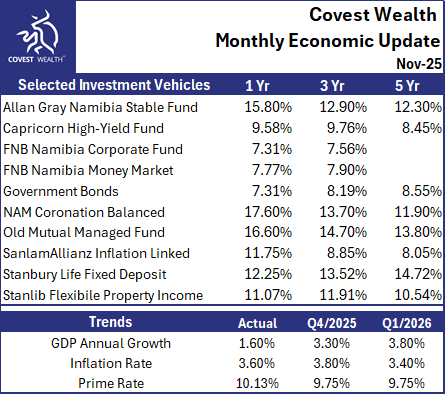
The Namibian economy struggled to grow in the middle of the year. The official data from the NSA shows that growth for the second quarter of 2025 (Q2 2025) dropped sharply to just 1.6 percent, the slowest pace recorded since the recovery started after the pandemic.
“This slowdown hit our core industries hard,” says Pieter De Klerk, CEO of Covest Wealth. “The manufacturing sector, which includes factories and producers, saw its total production plunge by 9.7 percent in the second quarter.”
Because of this sluggishness, economists predict that total economic growth for all of 2025 will only be about 3.0 percent. The hard times are also hitting families, as the total money spent by households on things like shopping and bills fell sharply by 7.2 percent.
Your Loans Just Got Cheaper, But Prices May Rise
Here’s the good news for your wallet: the central bank is making it cheaper to borrow money. In October 2025, the Bank of Namibia cut its main lending rate, known as the Repo Rate, to 6.50 percent. This forced commercial banks to drop their customer loan rates, meaning the main loan interest rate (Prime Rate) is now 10.125 percent.
“While prices aren’t soaring—inflation is still low at 3.6 percent in October 2025—that may change soon,” warns De Klerk. “The government announced a fuel price increase for December 2025, which will make transport and goods more expensive.”
Banks Are Only Lending to Big Business
While loans are cheaper, banks are mainly helping big businesses, not regular people. Total lending by banks grew by a decent 6.5 percent over the last year, but most of that money went to corporations.
“Businesses are borrowing heavily, with corporate credit up 9.46 percent to buy equipment and vehicles,” explains De Klerk. “However, the total amount of money owed for home loans is actually shrinking by 0.28 percent, meaning people are barely taking out new mortgages.”
While vehicle financing is strong, families are cutting back on using their bank overdrafts, which fell by 10.3 percent.
Uranium and Diamonds Keep the Lights On
Namibia relies on its mines to pay for imported goods. The country’s trade performance confirms this: in September 2025, Namibia sold N$7.4 billion worth of goods but imported N$10.8 billion worth, resulting in a trade gap (deficit) of N$3.4 billion.
The biggest surpluses—money coming in—came from uranium (N$1.6 billion) and diamonds (N$1.3 billion), while the biggest holes—money going out—were for essential imports like petroleum oils (N$1.8 billion) and fertilizers (N$523 million). Following a major debt payment in October, our foreign cash reserves dropped to N$48.57 billion, which is enough to pay for about 3.2 months of imports.
“While we wait for the broader economy to pick up speed, the good news is that there are still several investment vehicles available that provide above-market returns,” concludes De Klerk. “Smart savers and investors can continue building wealth while we await the full recovery to reach every corner of the country.”


