Placido Hilukilwa
NAMIBIA is a vast arid country blessed with remarkable landscapes but challenged by scarce and highly variable water resources, said Agriculture Minister Inge Zaamwani during the 7th Plenary of the African Union Water Investment Summit 2025 held in Cape Town, South Africa, last week.
“We are one of the driest countries in sub-Saharan Africa, and climate change is intensifying our water security challenges,” she said before declaring Namibia’s determination to turn the challenges into opportunities for innovation, partnerships, and sustainable investment in line with Sustainable Development Goal 6.
She reaffirmed Namibia’s concrete commitments to water and sanitation investment.
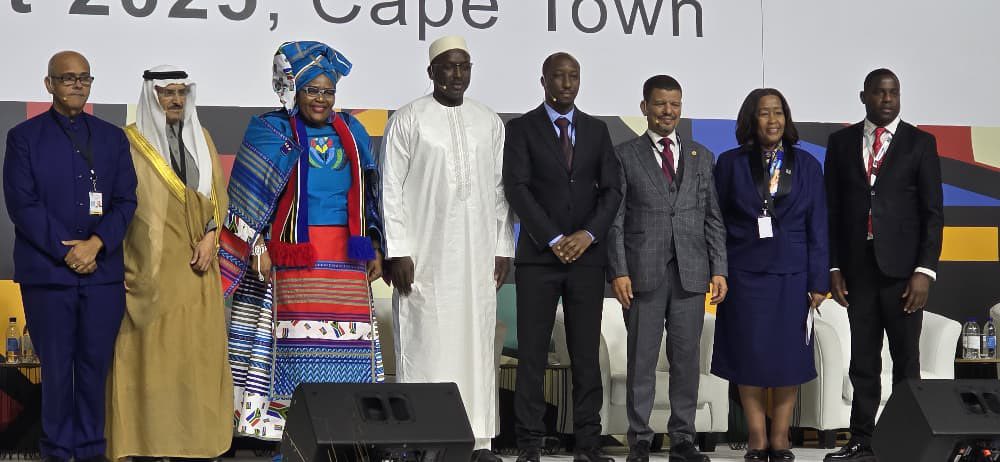
Photos: Ministry of Agriculture, Fisheries, Water & Land Reform
“The Cabinet has approved that 5% of the national budget be allocated to water and sanitation investment. We might not be there yet, but we have made national strides,” she said.
She pointed out that the Government has allocated N$2.8 billion over the current Medium-Term Expenditure Framework for priority water and sanitation infrastructure.
“These funds,” she said, “will support rural water supply schemes and sanitation facilities targeting underserved communities to ensure that no Namibian is left behind.”
In addition, she said, the Government has secured about N$4 billion in concessional loans from the African Development Bank and KfW for the next medium-term expenditure. These resources are earmarked for large-scale projects that will improve bulk water conveyance, rehabilitate ageing infrastructure, and expand sanitation coverage in both rural and urban areas.
She said the Government is also committed to carrying out a joint feasibility study on the Noordoewer–Vioolsdrift Dam on the Orange River to the tune of US$2.5 million, to be equally contributed by Namibia and South Africa.
“The capital cost requirement for the dam construction is about US$231 million, which we are hoping to attract interest from investors,” said Zaamwani, noting that the project is important for long-term water security for the social and economic development of the two nations and the Ecological Water Requirements (EWR) in the Lower Orange River.
She said: “We know that public financing alone is not enough. Namibia is therefore advancing public-private partnerships as a core part of our water security strategy.”
In her speech to the AU-AIP indaba, Zaamwani identified another “flagship initiative project,” namely the planned coastal desalination plant, to be developed with private investors in a public-private partnership.
“This facility,” she said, “will supply water to the mining sector, which is critical to our economy, and to coastal towns, thereby relieving pressure on the limited local groundwater sources.”
According to the Minister, the project reflects the commitment to diversification of water sources, enhancing climate resilience, and promoting economic growth.
The investment drive is, however, not limited to infrastructure.
“We are equally committed to building the institutional and technical capacity needed to operate and maintain this infrastructure sustainably. This includes strengthening our water governance frameworks, improving cost-recovery mechanisms and efficiency, and expanding skills training for the water sector workforce, also in project preparation and management capacity,” she said, as she recognised that water security is inseparable from food security, energy security, public health, tourism, and economic competitiveness.
For that reason, Namibia approaches water investment not as an isolated sectoral issue, but as a driver of national development and regional integration.
Zaamwani said that the Cape Town Summit has provided information and a vital platform to mobilise resources.
Namibia pledges to maintain, attract, and grow the country’s investment in water and sanitation through domestic financing, concessional loans, grants, and private partnerships until every Namibian has reliable access to safe water and adequate sanitation.