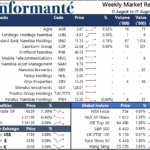
Namibian equity markets maintained their positive momentum this week, with the NSX Local index posting a modest gain of 0.05% to close at 753.9 points, while the NSX Overall Index delivered a robust advance of 2.38% to reach 1811.9 points. As of August 17, 2025, the market capitalization rankings among leading companies remain stable. FirstRand Namibia continues to hold the top position with a market value of N$12.5 billion, followed by Capricorn Group at N$11.4 billion, Mobile Telecommunications at N$6.4 billion and Namibia Breweries at N$6.0 billion. Agra led the market this week, with its shares rising 0.5% to close at N$3.87 per share. Letshego Holdings Namibia secured second place among gainers, advancing 0.3% to settle at N$6.62. Trading activity was highest for Standard Bank Namibia Holdings, which saw N$1.1 million worth of shares changing hands during the period. Capricorn Group recorded the second-highest trading volume with N$300,000 worth of shares traded. The Namibia Dollar continued its strengthening trend against major currencies this week. It gained 0.88% against the US Dollar to close at N$17.59, advanced marginally by 0.08% against the British Pound to finish at N$23.85, and strengthened 0.39% against the Euro to end at N$20.58.

The Bank of Namibia’s Monetary Policy Committee has unanimously decided to hold the repo rate steady at 6.75 percent, prioritizing the preservation of the crucial currency peg between the Namibia Dollar and South African Rand while simultaneously providing support to the domestic economy. The decision comes as Namibia’s economy continues to show signs of expansion, though at a more measured pace than previously observed. Economic activity grew during the first half of 2025, but the momentum has slowed compared to the same period last year. Despite this deceleration, economic forecasters remain optimistic about the country’s trajectory, projecting real GDP growth of 3.5 percent for 2025 and 3.9 percent for 2026, compared to the 3.7 percent recorded in 2024. On the inflation front, Namibians have experienced welcome relief as price pressures have eased considerably. Annual inflation averaged 3.6 percent during the first seven months of 2025, representing a significant improvement from the 4.8 percent rate observed during the corresponding period in 2024. Looking forward, monetary authorities expect inflation to remain relatively contained, forecasting averages of 3.8 percent for 2025 and 4.2 percent for 2026. Namibia’s merchandise trade deficit has shown marked improvement, narrowing by 28.2 percent to N$12.8 billion during the first six months of 2025 when compared to the same period in the previous year. This improvement in trade performance has been accompanied by a strengthening of the country’s financial buffers. International reserves have grown steadily, climbing to N$58.1 billion by the end of July 2025 from N$57.4 billion recorded at the end of May. This increase has been primarily driven by receipts from the Southern African Customs Union, reinforcing Namibia’s financial stability. The current level of foreign reserves provides the country with an estimated import cover of 3.8 months, offering adequate protection against external economic shocks.