Staff Reporter
The Minister of Agriculture, Water and Land Reform, Calle Schlettwein, emphasised that the pursuit of economic growth should not overshadow the need for environmentally sustainable action regarding the country’s mining and energy ambitions.
“Policymakers perceive the need for development as first and foremost an economic issue—how money is made and distributed across generational timespans. However, environmental considerations, especially the effects of climate change, must be addressed simultaneously to ensure a safe and healthy life now and for future generations,” Schlettwein said.
He highlighted that Namibia’s landmark green hydrogen project is being developed within a proclaimed national park and funded through the Environmental Investment Fund (EIF). This, he said, is despite the fact that the country’s national parks are proclaimed to protect and conserve biodiversity and ecological systems and processes on state land, not to develop industries. According to him, using national parks to develop industries, even if those industries are called “green”, is a misuse of statutory power.
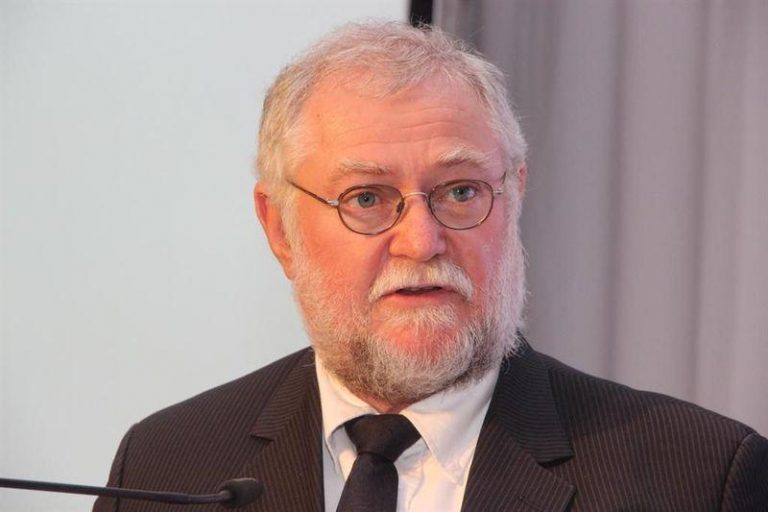
“Leasing state land falls under the statutory functions of overall land administration; its demarcation is a function of the Surveyor General. Designating state land for specific use is therefore governed by laws made in Parliament that grant regulatory and administrative power to several, but specific, institutions and office-bearers,” Schlettwein said.
The minister emphasised that leasing out state land for industrial development cannot be addressed through legislation covering the administration and upkeep of national parks established to preserve and protect biodiversity and natural ecological systems and processes. The rule of law, he said, dictates that institutions and their office-bearers can only exercise powers if they are provided for in a statute.
“A similar situation is developing in the Kalahari Desert. Mining licences may be granted for mining methods that risk permanently polluting a substantial groundwater aquifer on which human lives and livelihoods depend, as well as natural life. This involves uranium being mined with all tailings discharged into the aquifer. Exploration is already under way,” Schlettwein said.
He explained that the Stampriet Aquifer is the only reliable freshwater source for an ecosystem and a community of about 80,000 people. According to Schlettwein, the economic gains from uranium mining would have minimal benefit for the local community, if any.
“In the very old and sensitive ecosystem of the Kalahari Desert, some parts could be completely lost,” he added.
The minister pointed out that the mining and energy sectors are being portrayed as potential saviours of the Namibian economy and are gaining traction on the development agenda. However, he cautioned, these sectors’ track record does not justify such hopes.
“Where mining has produced immense wealth, it has not benefited local communities but rather multinational entities elsewhere. The energy sector does not have the capacity to satisfy all of Namibia’s power demands, providing only about 60% of the power, nor does it meet energy needs, with 0% of oil- and gas-based energy provided from Namibian sources. If the goal is power and energy self-sufficiency (which it should be), both subsectors fall drastically short. They must therefore be fundamentally realigned to serve Namibia’s economic needs, rather than exclusively those of foreign investors,” Schlettwein said.
He emphasised that the utilisation of natural resources, both renewable and non-renewable, must be regulated and implemented transparently and accountably.
“Environmentally sustainable utilisation of resources—without destroying ecological systems, especially fragile and unique ones such as those in the southern Namibian Desert—must take precedence over economically driven priorities that are not environmentally sustainable or do not create meaningful wealth in Namibian communities,” Schlettwein added.