Staff Reporter
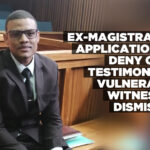
FORMER Magistrate Jaco Kennedy, who stands accused of several counts of rape, had his application challenging the use of CCTV testimony by vulnerable witnesses dismissed by three High Court judges.
In June 2022, Kennedy applied to the court to declare sections 158A(1) and/or (2)(d) of the Criminal Procedure Act (CPA) unconstitutional, arguing that they lacked any regulatory framework and ascertainable parameters to establish under which circumstances a vulnerable witness would be allowed to give testimony via closed-circuit television (CCTV). He claimed these sections were inconsistent with Article 12(1)(a) and/or (d) and/or Article 22(b) of the Namibian Constitution.
Secondly, he applied for the court to declare section 158A(3)(b) of the CPA in conflict with the presumption of innocence under Article 12(1)(d) of the Namibian Constitution and therefore unconstitutional.
The respondents, namely the Prosecutor General, the Attorney General, and the Minister of Justice, submitted that section 158A of the CPA serves a legitimate purpose and is rationally connected to that purpose—namely, to provide special arrangements for vulnerable witnesses in order to obtain their complete and undistorted evidence.
“Section 158A(7) provides that the interests of the state in adducing complete and undistorted evidence, the well-being of the witness concerned, the availability of necessary equipment and locations, and the interests of justice in general should all be considered when a court considers whether an order under this section should be made. Section 158A(6) provides that the accused, his legal representative, the prosecutor, and the presiding officer shall be able to hear and observe the witness while such witness gives evidence behind a screen or in another room,” the respondents said.
In their ruling, the three High Court judges—Nate Ndauendapo, Christie Liebenberg, and Herman Oosthuizen—found that section 158A of the CPA does not limit an accused’s right to a fair trial.
“The meaning is clear. Every relevant person shall be able to personally observe and assess the witness while they give evidence in chief, under cross-examination, and during re-examination. That essential right is preserved. Section 158A(3)(b) defines a vulnerable witness as a person against whom an offence of a sexual or indecent nature has been committed. It does not say or provide that the accused perpetrated the offence,” the judges said.
They further said that, considering the text, context, purpose, and meaning of the words used in section 158A as a whole, the court fails to observe the ambiguity complained of.
Kennedy, along with a co-accused, Raymond Cloete, is alleged to have kidnapped a woman in Windhoek on 3 January 2015 and raped her near the Katutura Intermediate Hospital.
Kennedy is also individually charged with kidnapping and raping another woman in the city on 31 December 2015, following his and Cloete’s release on bail for the charges related to the first incident. He has been in custody since late January 2016, when he was arrested on a second charge of rape within 13 months.