
Staff Reporter
A TOTAL of 389 wildlife crime cases were registered in 2023, resulting in the arrest of 654 suspects.
This is according to the Ministry of Environment, Forestry and Tourism’s Wildlife Protection and Law Enforcement Status Summary for 2023, which revealed that the registered wildlife-crime cases and arrests were lower than those recorded during 2022 for most categories. The report further revealed that of the 389 registered wildlife crime cases, 96 were finalised.
“The overall number of registered cases has decreased by 12%, while arrests have decreased by 8%. The number of registered cases related to high-value species has increased by 3%, with a sharp increase in pangolin-trafficking cases, of 67%, making the most significant difference. Cases related to high-value species made up close to 47% of all registered cases,” the report reads.

FIGHTING WILDLIFE CRIMES: Scenes from the National Stakeholder Forum for Wildlife Protection and Law Enforcement. Photos: Ministry of Environment, Forestry and Tourism. 
FIGHTING WILDLIFE CRIMES: Scenes from the National Stakeholder Forum for Wildlife Protection and Law Enforcement. Photos: Ministry of Environment, Forestry and Tourism. 
FIGHTING WILDLIFE CRIMES: Scenes from the National Stakeholder Forum for Wildlife Protection and Law Enforcement. Photos: Ministry of Environment, Forestry and Tourism. 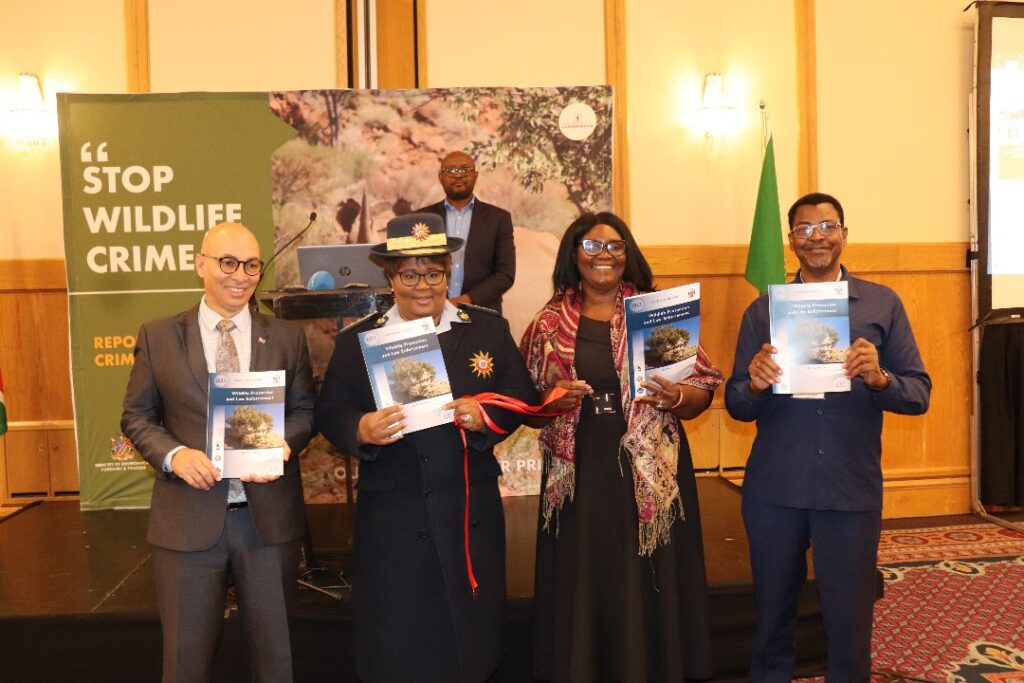
FIGHTING WILDLIFE CRIMES: Scenes from the National Stakeholder Forum for Wildlife Protection and Law Enforcement. Photos: Ministry of Environment, Forestry and Tourism.
The report also highlights that 69 rhinos were poached last year, with 83 suspects arrested in connection with these incidents. Despite concerns, the report indicates a 29% reduction in rhino poaching compared to 2022.
“The number of rhino horns seized by law enforcement increased threefold, but remains comparatively low – 15 horns were recovered while 69 rhinos were poached (positive DNA matching of carcasses and horns takes time). The 39 pre-emptive arrests achieved in 12 cases during 2023 (out of a total of 83 rhino-related arrests in 90 cases) again saved rhinos,” the report continues.
The report further reveals that eight elephants were poached last year, leading to 56 arrests, primarily for trafficking ivory sourced from outside Namibia. Additionally, 102 elephant tusks were confiscated in 2023, predominantly originating from elephants killed in other countries.
“The number of elephants known to have been poached doubled again from 2022, but remains low at 8 animals. Seizures of ivory increased by 86%, and included particularly large ivory (the number of registered cases related to elephant was actually slightly lower than in 2022). Collaborative transboundary investigations showed that several large seizures (more than 10 tusks each) originated from elephants poached in neighbouring countries,” the report disclosed.
Moreover, the report mentions that over 70 pangolins were poached last year, leading to 106 arrests.
“Pangolin seizures showed a similarly dramatic increase from 40 to 70 animals (75%), which was also reflected in the number of cases related to pangolin being registered,” the report added. In addition to this, the report revealed that 326 elephant’s foot plants were poached in 2023, resulting in 19 arrests.
“Elephant’s foot, Adenia pechuelii, is amongst the most-targeted individual species, at least according to seizure records. During 2023, investigations in 7 registered cases resulted in the seizure of 326 plants. Elephant’s foot is a slow-growing arid-habitat species with a localised distribution, with solitary plants sparsely dotted across vast landscapes. The plant is classified as endemic to Namibia4. The loss of so many individual plants is likely to have a massive impact on the population viability of this species,” the report explained.