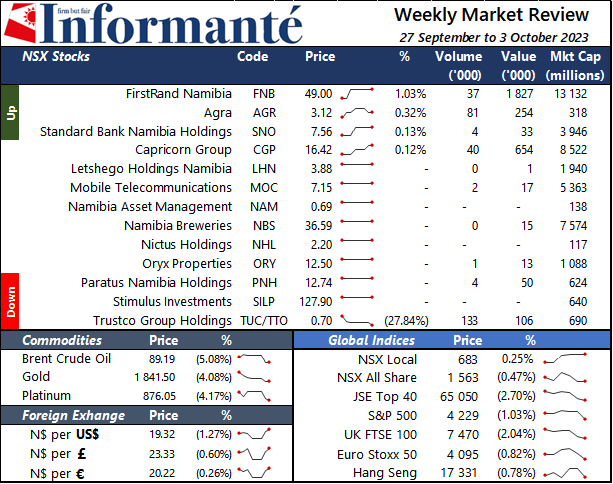
In the local stock market this week, the NSX Local index recorded a gain of 0.25%, closing at 683.2 points, while the NSX Overall Index experienced a slight decline of 0.47%, ending the week at 1562.5 points. As of October 3, 2023, FirstRand Namibia maintained its position as the largest local company on the exchange, boasting a market capitalization of N$ 13.1 billion. Following closely were Capricorn Group with N$ 8.5 billion, Namibia Breweries with N$ 7.6 billion, and Mobile Telecommunications with N$ 5.4 billion in market capitalization. During the trading week, FirstRand Namibia led the market’s performance, closing at N$ 49 per share, reflecting a growth of 1.0%. Agra secured the second position, closing at N$ 3.12 after a marginal gain of 0.3%. In terms of trading volume, FirstRand Namibia took the lead with N$ 1.8 million worth of shares traded, while Capricorn Group followed closely with N$ 0.7 million worth of shares traded. The local currency faced some fluctuations during the week, witnessing a 1.27% depreciation against the US Dollar, closing at N$ 19.32 per USD. Additionally, it lost 0.60% against the British Pound, closing at N$ 23.33 per GBP, and concluded at N$ 20.22 against the Euro, reflecting a 0.26% decline.
Namibia’s economic outlook for the coming years points to a slowdown in GDP growth, according to the Bank of Namibia’s latest Economic Outlook report. The nation’s economy, which posted a robust 4.6% growth in 2022, is projected to grow at a more modest rate of 3.3% in 2023 and 3.0% in 2024. This shift is attributed to weaker global demand and base effects, especially within the diamond mining sector. Key sectors in Namibia’s economy offer a mixed outlook. Primary industries, particularly agriculture, are expected to contract due to persistent drought conditions. Mining will continue to grow, albeit at a more moderate pace. Secondary industries are poised for moderate growth, driven by a resurgence in construction, while the manufacturing sector may experience a slowdown. Tertiary industries, including retail and hotels, are likely to decelerate compared to 2022 levels. Namibia’s economic prospects bear both downside and upside risks. Challenges such as global monetary tightening, sustained high commodity prices, water supply issues, and electricity disruptions weigh on the downside. On the positive side, the mining sector and upcoming mining and oil/gas projects hold the potential to uplift the nation’s economic trajectory.