Staff Reporter
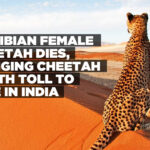
ON 3 August 2023, a wild Namibian female Cheetah named Tbilicy, relocated to India, died, bringing the death toll of Cheetahs relocated from Namibia and South Africa to India to nine.
This was shared by Vincent van der Merwe, Manager of the Cheetah Metapopulation project. Explaining the cause behind the high increasing mortality rate, van der Merwe explained that the Cheetahs experienced a ‘winter coat’ issue.
“African cheetahs develop a winter coat in autumn (April & May), in anticipation of impending cold conditions. These coats developed just before the extreme heat and humidity of the monsoon summer rains in India. This year, Kuno National Park in India experienced double the average rainfall figures for July (321mm). The moisture and heat in the thicker winter coats, combined with high external parasite loads, resulted in localized skin infections (dermatitis). This was followed by fly strike (myiasis), with the infection spreading, and the cheetahs eventually succumbing to blood poisoning from bacterial infection (septicaemia). The habituated cheetahs that could be approached within 20m were captured and treated with a long-acting systemic antiparasitic treatment (Fluralaner). The wilder individuals sourced from Namibian farmland, as well as the Kalahari and Waterberg regions of South Africa, could not be captured and treated, resulting in the recent three mortalities,” van der Merwe explained.

He further said that the most recent of those deaths include a Namibian female cheetah who succumbed to this condition on 3 August. He shared that from the Cheetahs relocated to India, two Namibian adult cheetahs have died, while four Cheetahs from South Africa and three cubs also born in India died.
“As with the South Africa experience in cheetah reintroduction, these issues constitute ‘growing pains’ that form part of the reintroduction process. It took South Africa 26 years to perfect the cheetah reintroduction process. Over 200 cheetahs sourced from Namibia were lost between 1966 and 1996, when nine of the initial 10 South African reintroduction attempts failed. We cannot expect India to get this right with 20 cheetahs. India will go through the same growing pains. The successful implementation of Project Cheetah will hopefully initiate the recovery of wild cheetah populations across their historical distribution range in southern and central Asia,” Van der Merwe said.
The South African wild cheetah metapopulation continues to grow at a steady rate of 8% (approx. 40 individuals) per year. Botswana, Namibia, and South Africa host the largest wild cheetah populations worldwide, estimated at approximately 1480, 1420, and 1270 individuals in each country, respectively (58% of the global population). Six reintroductions are in process within South Africa this year.
The further supplementation of wild cheetah populations in neighbouring states is underway, with 24 South African cheetahs earmarked for Malawi, Zambia, and Mozambique. Van der Merwe said these measures have been put in place by the South African government to deal with the problem of surplus wild cheetahs and will prevent the requirement for management actions that include contraception or euthanasia.