Staff Reporter
THE Southern African Science Service Centre for Climate Change and Adaptive Land Management (SASSCAL) has announced the official launch of the first Green Hydrogen Atlas Southern Africa results, an interactive map that aims to demonstrate the generational potential of Green Hydrogen in Southern Africa.
The atlas, known as the H2Atlas, was officially launched by SASSCAL’s Executive Director (ED), Dr Jane Olwoch, and Dr Solomon Agbo, the coordinator of the H2Atlas Africa at Forschungszentrum Jülich GmbH, along with regional technical committee and national teams. More than 13 countries, 60 scientists, 16 modellers, and 12 regional technical committee teams participated in the project.
The project was sponsored by the German Federal Ministry of Education and Research (BMBF), with SASSCAL serving as the coordinating partner in Southern Africa. SASSCAL collaborated with the SADC Centre for Renewable Energy and Energy Efficiency (SACREEE) as a technical implementing partner.
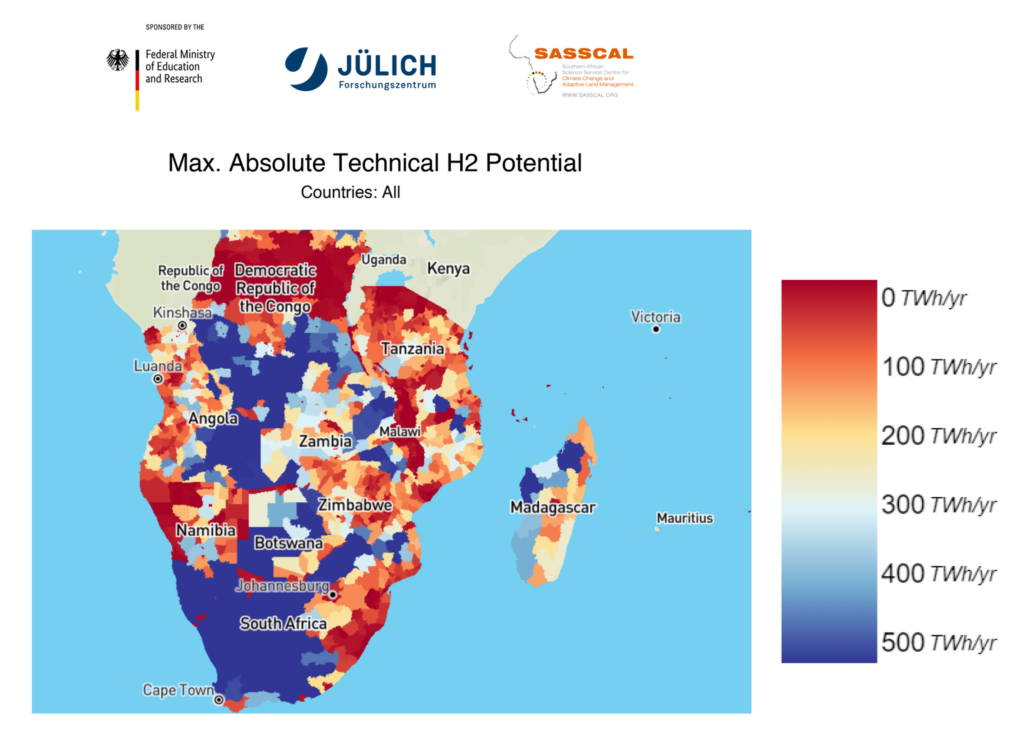
“The project results presented in the form of an interactive atlas shows the locations of interest in 12 Sothern African countries. The Atlas serves as the first science-based decision support tool for the concept and design of green hydrogen pilot plants to be developed,” said SASSCAL’s liaison officer, Kalkidan Tesema.
Tesema explained that the atlas aims to provide evidence-based information on various resources for the production of green hydrogen. These resources include water resources, land availability, renewable energy resources such as solar and wind energy, and the levelized cost of hydrogen production. Tesema also mentioned that the atlas provides key indicators related to social aspects, policy frameworks, export and transport, as well as political and energy regulatory frameworks.
“These are key elements for policymakers, investors, researchers, and potential funders interested in the potential of Green Hydrogen development in Southern Africa,” Tesema said.
Furthermore, Tesema added that the atlas can contribute to the development of national and regional roadmaps and strategies to enable a green hydrogen-based economy in sub-Saharan Africa. It is of great relevance to both Germany, Africa, and the global community. The project results provide relevant information that German and African businesses/industries can leverage in partnership to provide the appropriate technology for sustainable development.
The official launch of this project was preceded by the announcement of the project’s completion by Bettina Stark-Watzinger, the Minister of the Federal Government of Germany, during the launch and award ceremony of the pilot projects and the Youth for Green Hydrogen Scholarship programme in March.
The atlas can be accessed at https://africa.h2atlas.de/.