Zorena Jantze
NAMIBIA’S uranium production jumped to its highest levels in history, with the country surpassing both Australia and Canada to become the world’s second largest primary producer of uranium oxide (U3o8) after Kazakhstan which continues to dominate the market from a supply side.
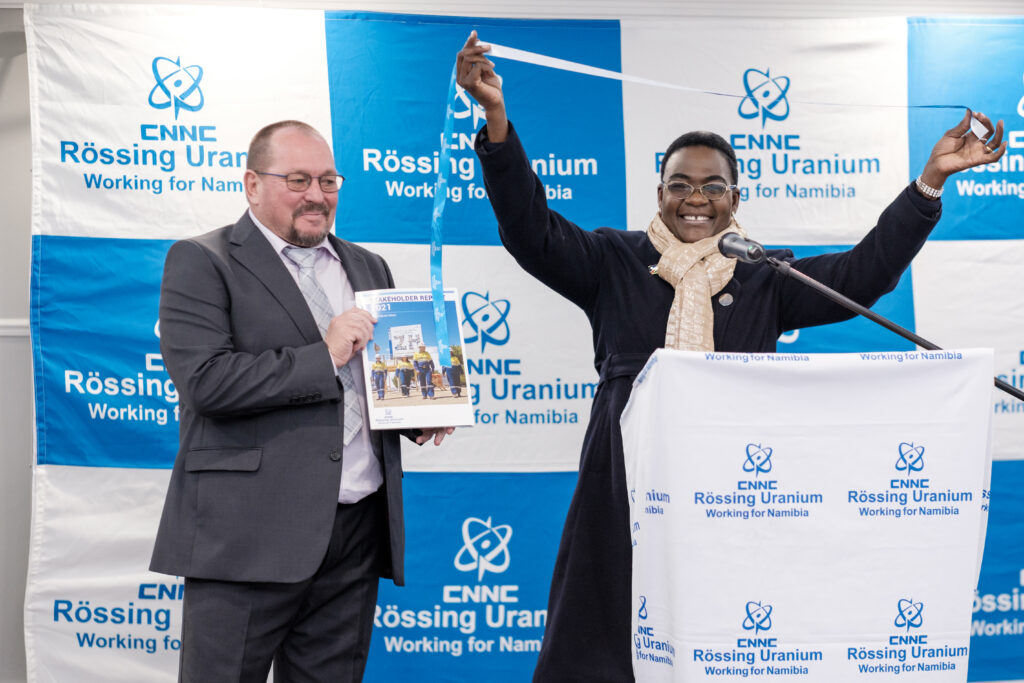
This was revealed by China National Nuclear Corporation’s (CNNC’s) Rössing Uranium in their stakeholder report launched on 8 June.
Despite production volume being 11% higher than in 2020, the mine’s revenue was 6% lower due to the impact of a stronger Namibian dollar against the US dollar, as the mine currently sells all its products in U$ dollars.
Total revenue amounted to N$4.26 billion in 2021 compared to N$4.52 billion in 2020.
Giving a keynote address at the launch of the stakeholder report, Rössing Uranium’s managing director Johan Coetzee stated that the company exceeded budgeted production targets by a significant margin, as the 2 882 tonnes of U3o8 produced during 2021 represent a 16% increase compared to 2020.
“To produce this product, we had to mine 20.7 million tonnes of rock and process 9.6 million tonnes of ore,” Coetzee said.
Touching on the future survival of the mine, the MD said that there are plans underway to expand the life cycle of the mine which is scheduled to close by 2026.
“With the support of our Board and Directors and shareholders, we a working very hard to secure a longer-term future and continued employment security for the mine and our employees.
“In November 2020, the Board of Directors approved funds to complete a bankable feasibility study for extending the life-of-mine beyond 2026. This is underpinned by a north-eastern extension of our existing open pit, referred to as the Phase 4 pushback, which can provide sufficient ore to continue production for another ten or more years,” Coetzee said.
Rössing Uranium paid the government N$111 million in royalty tax and N$167 million as pay-as-you-earn tax on behalf of employees. No corporate tax dividends were paid in 2021.
Rössing had a total of 943 permanent employees, 99% of them being Namibians during the reporting period.
The mine’s report also detailed that 20% of its workforce are women and that they are well represented across all levels of our organization.
The MD said Rössing Uranium currently sells a portion of its product into an existing long-term contract portfolio, and the remaining available production was sold to the China National Nuclear Corporation (CNNC) Group.
“In 2021, 76% sales volume was delivered to Asia, of which 90% has been sold to the majority shareholder CNUC/CNNC. The remaining 26% sales volume was delivered under the long-term contract portfolio to North America, Europe, the Middle East and Africa,” he said.
Cootzee said most of the procurement expenditure was on local suppliers, amounting to N$2.25 billion or 75% of total procurement expenditure. 14% of procurement spending went to South Africa, whilst the remaining 11% was spent internationally.