
Staff Reporter
THE Fourth Industrial Revolution (4IR) represents an era of great promise that could enable Namibia and Africa to catch up with the developed world but people should be mindful of the challenges and have a solution mindset.
President Hage Geingob made these remarks during his official opening speech at the 4IR Conference on Wednesday, which was organised by the eight-member Namibia 4IR Task Force that the president appointed in 2021.
One of the challenges that Geingob highlighted concerning the 4IR is that automation and artificial intelligence (AI) could lead to job obsolescence and job cuts. However, he assured that the government is committed to mitigating the associated risks and prioritised agriculture, health, finance, defence and education as the sectors where the 4IR technologies can be used to increase production, create jobs and ensure food security.
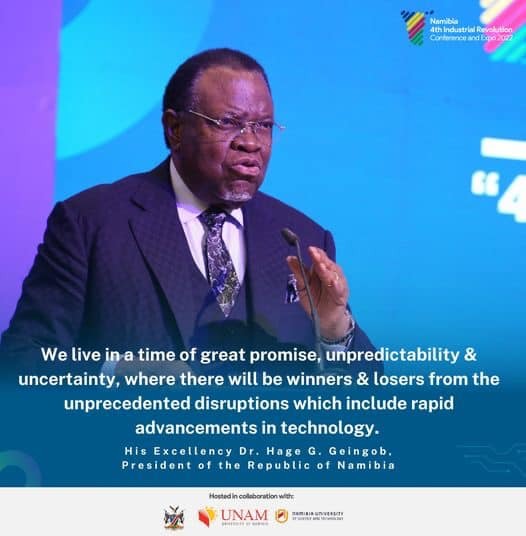
Geingob said the country needs a deeper understanding of the convergence of technologies and their effects on the labour markets, skills requirements, ways of working and the tools required to augment worker capacities. He said this starts with education, but noted that the education system and industry have relatively low capacity to react to the rapid technological changes. He, therefore, called for a fundamental shift in education.
“One leverage point is equipping primary and secondary learners with the combination of verbal and written communication, logical and numerical skills, to nurture the ability to code and think computationally and by so doing, develop holistic problem-solving skills. It has become increasingly important to deliver multi-disciplinary training in our institutions of higher learning, through blended curricula,” the president said.
Geingob acknowledged that the 4IR could exacerbate inequalities in the country. He highlighted that people should be at the centre of the social and economic change, with special focus paid to Rural Development Strategies to ensure that marginalised communities and young people facing challenges are supported equitably to break out of cycles of poverty.
“We are acutely aware that rapid technological advancements, not matched with requisite levels of investments, bear the risk of leaving more people behind and widening the inequality chasm in our society. Owing to the pervasive nature of these technologies, we cannot escape from or entirely avoid a digital future,” the president said.
The president said that Namibia not only intends to become industrialised, but the country also aspires to become an inclusive and green nation by 2030. He pointed out that Namibia has already embarked on a green future and positioned itself as a global producer of green hydrogen and ammonia. He said the country is also receiving carbon credits for using blockchain technology to develop a verifiable record for green hydrogen production.
The president said there are projects underway to teach the youth to develop drones and bush aircraft. He added that last week the Namibia Institute of Pathology showcased drones that will deliver and collect medical specimens to remote communities in the Kunene and Zambezi regions. This project was done in partnership with United Nations Children Fund (Unicef).
The Fourth Industrial Revolution is a way of describing the blurring of boundaries between the physical, digital, and biological worlds. It is a fusion of advances in artificial intelligence (AI), robotics, the Internet of Things (IoT), 3D printing, genetic engineering, quantum computing, and other technologies.