


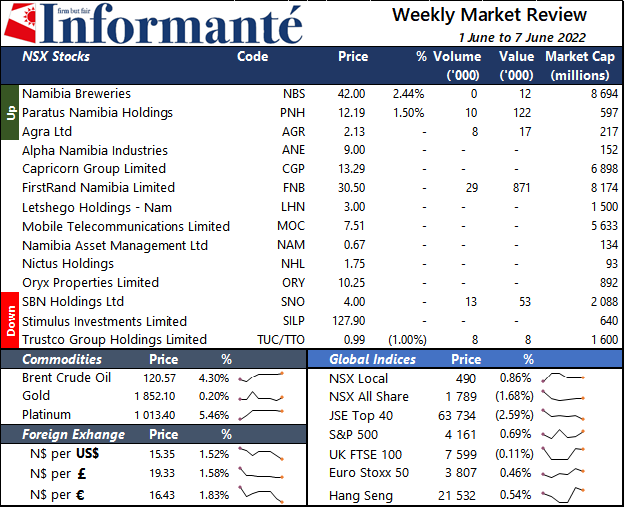
In the local market this week, the NSX Local index was up 0.86% at 490.2, and the NSX Overall Index was down 1.68% at 1789.3. As at 7 June 2022, Namibia Breweries was the largest local company on the exchange, with market capitalization of N$ 8.7 billion, followed by FirstRand Namibia Limited with N$ 8.2 billion, Capricorn Group Limited with N$ 6.9 billion and Mobile Telecommunications Limited with N$ 5.6 billion. Namibia Breweries lead the market this week, closing at N$ 42 per share after growth of 2.4%, with Paratus Namibia Holdings second, closing at N$ 12.19 after growth of 1.5%. In terms of volume FirstRand Namibia Limited lead the market with N$ 0.9 million worth of shares traded, with Paratus Namibia Holdings in second place with N$ 0.1 million worth of shares traded. The local currency gained 1.52% against the US Dollar, to close at N$ 15.35 per USD, and gained 1.58% against the British Pound, to close at N$ 19.33 per GBP. It closed at N$ 19.33 against the Euro, a gain of 1.83%.
The Namibia Statistics Agency released the Trade Statistics Bulletin for April 2022, and revealed that trade during the month decreased by 20.3%, with N$ 14.4 billion in trade compared to N$ 18 billion in February 2022. This is higher than the N$ 12.7 billion recorded in April 2021. Exports decreased by 36.4% to N$ 5.5 billion, with imports decreasing by 5.2% to N$ 8.8 billion. As a result, the country recorded a trade deficit of N$ 3.3 billion, expanding by 433.9% from March. The decrease in exports was mainly due to uranium decreasing by N$1.5 billion, inorganic chemical elements decreasing by N$482 million, Precious stones (diamonds) decreasing by N$285 million, Copper blisters decreasing by N$172 million, and Petroleum oils decreasing by N$87 million. The decrease in imports was due to petroleum oils declining by N$262 million, Sugars, molasses and honey declining by N$197 million, Civil engineering and contractors’ plant and equipment declining by N$146 million, Precious stones (diamonds) declining by N$124 million, and Taps, cocks, valves and similar appliances declining by N$93 million.
South Africa was Namibia’s largest export market (22.5%), as well as Namibia’s largest import market (41.4%). As such, most export goods left via roads (36.6%), with 64.3% of imports also done via road.


