Staff Reporter
RUSSIA’s military operations in Ukraine is to protect people subjected to bullying and genocide and aimed at “demilitarisation and de-Nazification” of the country.
On 24 February, President Vladimir Putin made this announcement in a television broadcast, declaring Russia could not feel “safe, develop and exist” because of what he claimed was a constant threat from modern Ukraine. On the same day, by air, land, and sea, Russia started its attack on Ukraine, a European democracy of 44 million people.
One week later, warplanes continue to bomb major cities while Russian forces have taken over the port city Kherson.

REFUGEES: More than one million people have fled from Ukraine since Russia launched its invasion, according to the UN: Photo Gleb Garanich/Reuters 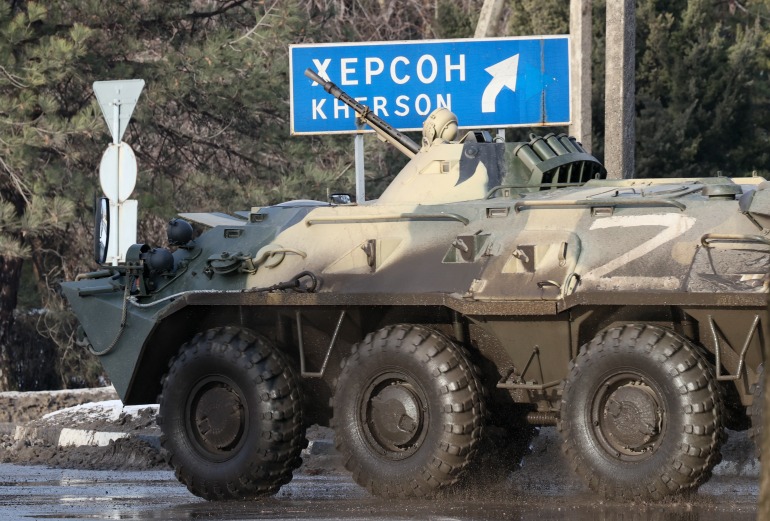
CAPTURED: Kherson is strategically located at the mouth of the Dnieper River’s exit into the Black Sea. Photo: Sergei Malgavko/TASS via Getty Images/Al Jazeera 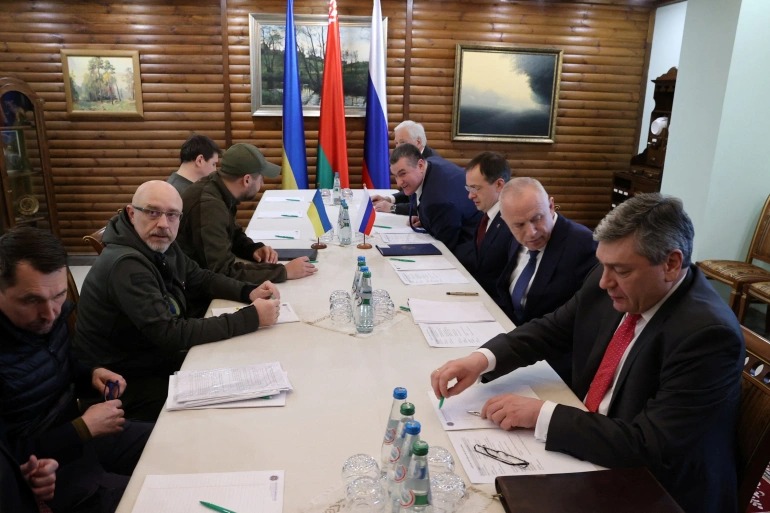
ROUND TWO: Delegations from Kyiv and Moscow met for a second round of talks. Photo: Maxim Guchek/Belta/Handout via Reuters/Al Jazeera 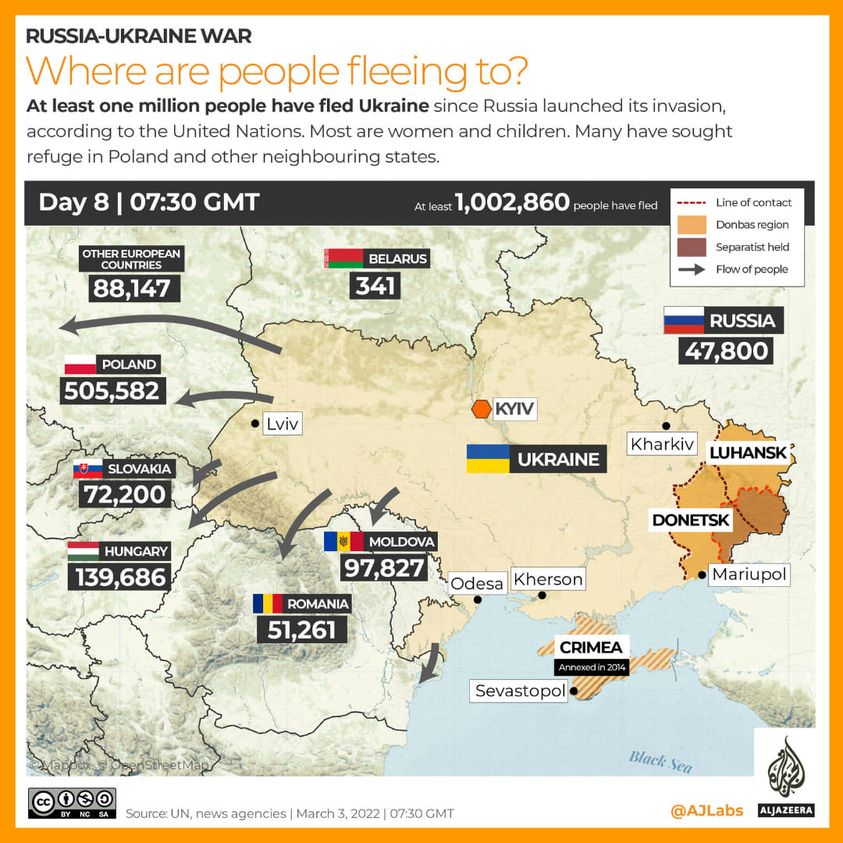
EXODUS: The countries where people fleeing from Ukraine have found refuge. Image: UN/AJLabs/Al Jazeera
Control of Kherson, home to about 300 000 people, is important because it could allow Moscow to mass troops there and use it as a launching post to push its forces further inland.
The United Nations says more than one million people have fled from Ukraine in what is described as the swiftest refugee exodus this century.
Russia refuses to use the terms war or invasion.
In response, the West is targeting Russia’s economy, financial institutions and individuals.
The EU, US, UK, Japan and Canada have cut off key Russian banks from the international Swift payment network, which allows the smooth and rapid transfer of money across borders.
The EU, UK and Canada have shut off their airspace to Russian airlines.
Personal sanctions are being imposed on President Putin and Foreign Minister Sergei Lavrov by the US, EU and UK, while 351 Russian MPs are being targeted by the EU.
Germany has halted approval on the Nord Stream 2 gas pipeline, a major investment by both Russia and European companies.
Russia’s state-run media Sputnik and Russia Today, seen as a Kremlin mouthpiece, are being banned across the EU.
The Russian city of St Petersburg will no longer be able to host this year’s Champions League final and the Russian Grand Prix will not take place in Sochi.
The International Paralympic Committee (IPC) has banned Russian and Belarusian athletes from competing, and has expelled them from the Games in Beijing.
The International Criminal Court (ICC) has started an investigation into potential war crimes by Russia.
President Putin has frequently accused Ukraine of being taken over by extremists, ever since its pro-Russian president, Viktor Yanukovych, was ousted in 2014 after months of protests against his rule.
Russia then retaliated by seizing the southern region of Crimea and triggering a rebellion in the east, backing separatists who have fought Ukrainian forces in a war that has claimed 14 000 lives.
Late in 2021, Russia began deploying big numbers of troops close to Ukraine’s borders, while repeatedly denying it was going to attack.
Then President Putin scrapped a 2015 peace deal for the east and recognised areas under rebel control as independent.
Russia has long resisted Ukraine’s move towards the European Union and the West’s defensive military alliance, NATO. Announcing Russia’s invasion, he accused NATO of threatening “our historic future as a nation”.
He faces stiff resistance from a deeply hostile population, but he has shown he is prepared to bomb civilian areas to fulfil his goals.
There is no immediate threat to Russia’s Baltic neighbours, but NATO has bolstered their defences just in case.
On Thursday, delegations from Kyiv and Moscow met for the second round of talks.
Kyiv was expected to press for a ceasefire and the establishment of humanitarian corridors during the latest set of discussions. – Sources: BBC News/Al Jazeera/Reuters