Niël Terblanché
MORE than three years after being arrested for growing cannabis and manufacturing medicine for her life partner from the plants at her home, Cheryl Green has entered a plea of not guilty in the Swakopmund Magistrate’s Court.
In her plea explanation, Green admits to cultivating the plants at her home but states that she used the plants and the seedpods to manufacture medicine for Rainer Kring, who suffers from multiple sclerosis, a debilitating disease.
The 60-year-old Green was arrested in February 2019 and spent several days in police custody before she was granted bail.
During a raid on her house, police officers found 71 cannabis plants, 26 grams of cannabis seeds and some cannabis oil on the premises.
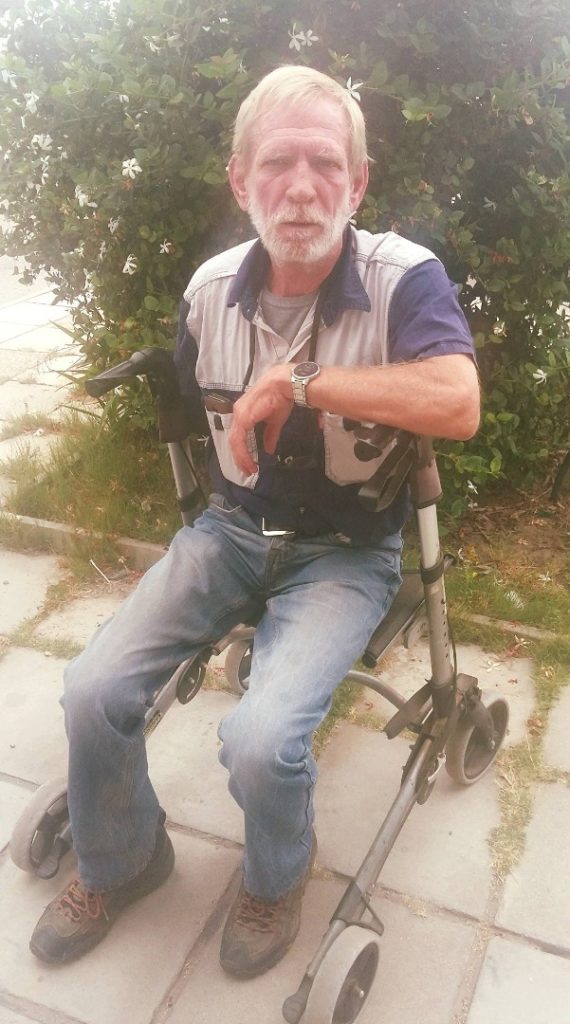
HERBALIST: Cheryl Green and her life partner Rainer Kring shortly after her arrest at the Swakopmund Magistrate’s Court. Kring suffers from Multiple Sclerosis and has been unable to walk since Green’s arrest. – Photos: File 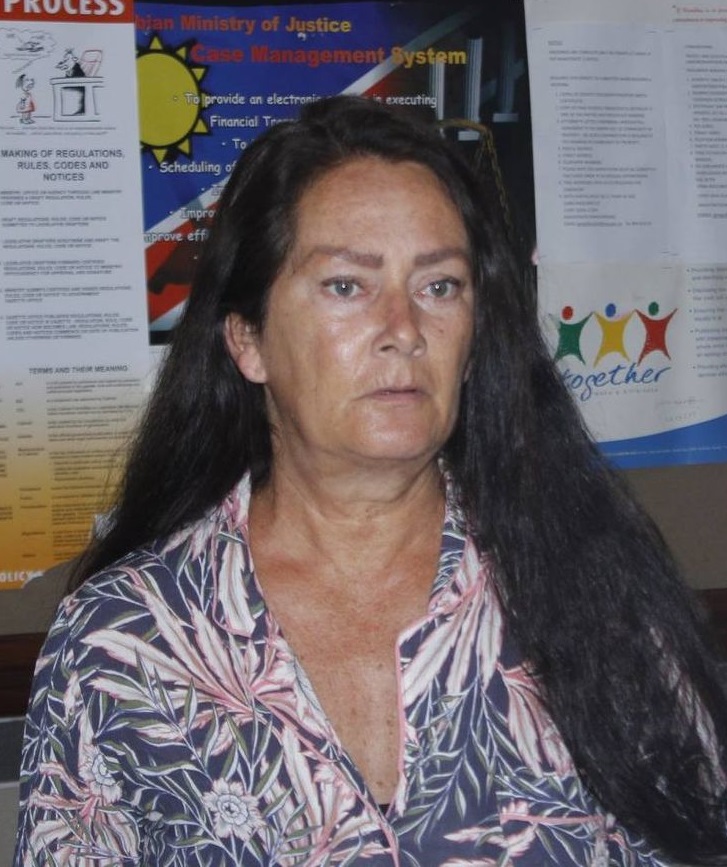
HERBALIST: Cheryl Green and her life partner Rainer Kring shortly after her arrest at the Swakopmund Magistrate’s Court. Kring suffers from Multiple Sclerosis and has been unable to walk since Green’s arrest. – Photos: File
The total weight of the plants after they have been uprooted was a little more than 3,6 kilograms.
The oil was valued at N$2 500, while the combined value of all the illicit material was estimated to be worth about N$21 904.
In her plea explanation, Green, who is represented by prominent lawyer, Richard Metcalfe, states that multiple sclerosis disrupts motor neurons in a person’s body which affects the normal functioning thereof.
The disease results in physical degeneration and eventually death of the sufferer.
“The condition leads to muscle weakness and atrophy to such an extent that basic voluntary muscle activity like speaking, swallowing, breathing and physical bodily movements are affected and deteriorate and eventually cease to function completely,” Green states in her plea explanation.
She further stated that she started a research project on the best and most effective treatment and a possible eventual cure for Kring’s debilitating disease.
“I am a herbalist with a master’s degree in herbalism, and an organic farmer, it goes without saying that my focus is always entirely on natural medicines,” she stated.
Green made it clear that the medicine that was prescribed to Kring was ineffective and that it had harmful effects on him, which led her to do research on the Sativa strain of cannabis plants.
She states that the active ingredient in the plant is effective for a diverse range of conditions, and it helps with neural regeneration.
She said that she learned that hemp, which is a variety of the cannabis Sativa plant, would be effective and as a result acquired seeds to plant at her home.
“I used the plants to produce a superior quality cannabis oil by combining virgin coconut oil and organic cannabis from my garden,” she explained.
She further stated that once her life partner started taking small doses of the oil at night, he quickly began to show noticeable improvement.
His sleep and appetite improved, and the pain he had been experiencing disappeared.
“Physical movement became possible again to the extent that he could walk short distances without a walker, and he started working again in his home workshop which was impossible before,” she said.
She said that after her arrest and the confiscation of her plants and other materials, Kring’s medical condition reversed to full-blown motor neuron disease.
“The forced removal of my hemp plants by the Namibian Police has removed my ability to produce oil for my life partner, and has effectively removed his constitutional rights to life and health,” she argued.
She further argued that hemp and cannabis plants come from different varieties of the Cannabis sativa plant and that Cannabis sativa is not a dangerous or prohibited dependence-producing substance.
“I admit that 71 hemp plants were found at my residence. I, however, emphatically deny that I had any knowledge that the cultivation of hemp seeds which I purchased at a local pharmacy and which are available at Swakopmund for purchase by any member of the public to legally possess, grow and utilise was unlawful,” she said.
She further stated that she only used the oil to help Kring and at no stage sold any parts of the plants or the oil she manufactured.
“This was intended specifically for the sole and personal use by myself for the benefit of my life partner and common-law spouse. The actions of the Namibian Police in seizing my hemp plants were an infringement of my constitutional right to privacy,” she said.
Green stands accused of transgressing Act 41/1971 Section 2A, which relates to the possession and dealing in prohibited dependence producing drugs or a plant from which such drugs can be manufactured.
The laws prohibiting cannabis and its use were carried over to Namibia from South Africa, but during September 2018, the South African Constitutional Court ruled that it is no longer illegal for adults to cultivate or use marijuana in private.
At the time, the landmark ruling handed down by the South African constitutional court made South Africa the third African country after Lesotho and Zimbabwe to decriminalise the use of cannabis that is widely grown across the continent despite its predominately illegal status.
Since then, several other countries on the continent such as Angola followed suit.
After noting the not guilty plea in court, the presiding magistrate postponed the matter to 25 October 2021 for the continuation of the accused person’s trial.