Niël Terblanché
THE Namibian Government will deploy two field hospitals from the country’s defence force to expand the ability of health authorities to treat the ever-increasing number of patients presenting at health facilities with COVID-19 symptoms.
The Minister of Health and Social Services, Dr. Kalumbi Shangula while addressing the nation from State House also gave the assurance that the 110 beds in the field hospitals along with 86 more beds that will be accommodated in buildings surrounding the Katutura State Hospital and a 100-bed unit that will be constructed in Windhoek will significantly add to the capacity of health workers to assist seriously sick patients.
He said one of the field hospitals will be deployed to the Oshakati Intermediate Hospital to mitigate difficulties experienced with increasing COVID-19 cases in the north.
“This will increase the number of isolation beds to 2024 countrywide and enhance access to medical care for those who will need it most,” he said.
Dr. Shangula added that deliberate steps have also been taken to improve the supply and availability of life-saving oxygen to the various health facilities.
He pointed out that three weeks ago, a 20-ton bulk oxygen tank was installed to provide oxygen to the 76-bed Respiratory Unit at Katutura Hospital, where COVID-19 patients are admitted.
“The existing bulk oxygen tanks at the Tsumeb and Walvis Bay State Hospitals, with the capacity of 6.5 tons each will also be filled as required to ensure adequate care. We have also engaged Afrox to install a 13-ton bulk oxygen tank at the Oshakati State Hospital soon. Also, a new gas generating unit with a capacity of producing 370 liters of oxygen per minute was installed one week ago at the Windhoek Central Hospital. It will supply the dedicated 15-bed COVID-19 ICU and High Care Unit at the Central Hospital,” he said.

He said a similar unit was installed at Walvis Bay Hospital with the support of the private sector last year.
“I also wish to inform that three hundred (300) portable oxygen cylinder have been delivered in Windhoek. They will be taken to Afrox to be filled and will be distributed to health facilities across the country, especially to facilities in remote areas. Government is also pursuing the option of procuring oxygen concentrators to be distributed to various public health facilities around the country as part of the intervention,” he said.
The health minister stated that oxygen concentrators can play a significant role in assisting patients in respiratory distress, but do not require high flow oxygen.
Regarding the dwindling vaccine stock in Namibia, Dr. Shangula said that those doses reserved for the second shot of the antigens will be used to administer the first shot to people that have not been vaccinated. The available doses will be used to vaccinate those receiving the first dose as well as identified persons considered to be at the highest risk of severe disease, hospitalization, and death.
“We will continue to vaccinate at sites where vaccine stocks are still available. This is the international best practice as other countries that have faced vaccine supply constraints have done the same. The fact of the matter is that some protection is better than none,” he said.
He said that getting vaccinated is the most effective way to protect the country against the onslaught of this dangerous pandemic.
“Namibians must stand together to fight and defeat the infodemic of false information and conspiracy theories. I urge all Namibians to form a united front in order to continue combating this pandemic. Assuring the continuity and uninterrupted vaccine in order to reach herd immunity is an ongoing pursuit. It requires a combined effort from all stakeholders, using each and every tool in our arsenal,” the health minister said.
Dr. Shangula said that the delivery of vaccines to the country has been delayed and that the government is working day and night engaging manufacturers and suppliers through diplomatic channels to get more vaccines into the country at the soonest possible time.
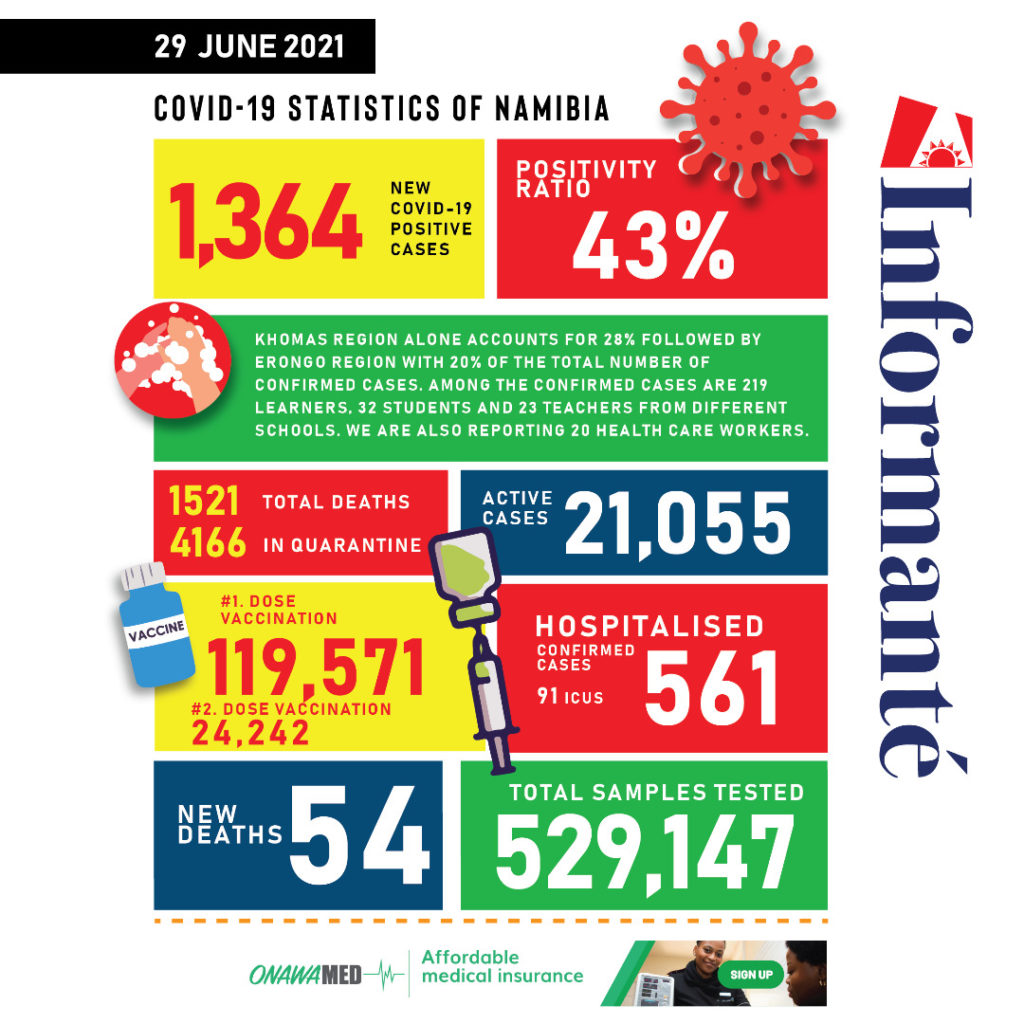
“Namibia has paid in full for 108 000 doses of Astra Zeneca via the COVAX facility. To date, 67 200 doses have been delivered. We expect the balance of 40 800 doses of the AstraZeneca vaccine to reach our country in July,” he said.
He said that the government has finalized orders for doses of Sinopharm, Astra Zeneca, and Johnson & Johnson vaccines and is awaiting delivery of these vaccines in the coming weeks.
Dr. Shangul said consignments of different vaccines such as the 40 800 AstraZeneca doses from the COVAX Facility are expected early in July.
The health authority is expecting 120 000 doses of Astra Zeneca ordered from AZ Europe to arrive in mid-July, 150 000 doses of Sinopharm ordered from China and 100 000 doses of Sinopharm ordered from the United Arab Emirates to arrive early in July while the Johnson& Johnson vaccine acquired through the Africa Vaccine Assistance Task Team (AVATT) is expected in Namibia by the first week of August.
The health minister said the expansion of bed capacity at certain focal points has been done because infections with SARS-CoV2 have increased exponentially along with the number of hospitalizations, and deaths.
There is hardly a family or a community in this country that has not been touched. We have all either buried a loved one whose death is attributed to COVID-19, or we know a friend or a neighbour who has. Our country is literally in an existential struggle again this pandemic. We are in a fight for our very lives,” Dr. Shangula said.