Niël Terblanché
COMPANIES that have invested billions of dollars in establishing shore-based processing capacity will pull on the short end again if quotas meant for the wet fish sector are converted and allocated to operators of freezer trawlers to be repacked onshore.
In a letter directed to the Confederation of Namibian Fishing Associations, the Minister of Fisheries and Marine Resources, Albert Kawana, states that he has considered a request by a company to convert quotas meant for the wet fish sector to freezer based processing if some of the work is done onshore.
The minister informed all stakeholders that he will not consider any request for conversion of horse mackerel from wet to freezer without convincing and verifiable motivation that the requested conversion is intended to promote more employment, as well as setting up onshore processing plants with a view to processing other marine species other than horse mackerel.
“Wet fish horse mackerel quotas are allocated for onshore processing at the factories for value addition and employment creation as outlined under NDP5. I have so far declined requests to convert quotas from wet to freezer. However, I will approve requests for conversion from freezer fish to wet fish for onshore processing and employment preservation,” Kawana said in his letter.
He added that before he decides on such requests, all stakeholders including union leaders will be consulted.
“As stated in previous communications to your association, the policy is to be biased toward wet fish,” he wrote.
He said that he looks forward to further consultations on the topic and made it clear that such proposals must include a definition of value addition.
A fishing company that is part of the Oceana Group and that has offices in Walvis Bay has offered to buy 8 400 tonnes of horse mackerel freezer quota at N$2 500 per ton that would total N$21 000 000 and 5 400 tonnes of wet quota at N$2 000 per tonne at a total of N$10 800 000.
The company offered to pay 50% of the N$31 800 000 purchasing offer upon signature of the agreement of the sale and the balance when the licensing of the freezer vessels to catch wet quota is completed. The company also offered a partnership in fishing vessels, as well as involvement in the value chain of the fish they will process on land if the partnership can be made long term.
In this regard, the Wet Landed Horse Mackerel Association requested clarity from Kawana regarding the possible permission to freezer trawler operators to catch wet quota and repack their catch on land.
“As per the policy of wet versus freezer quota, this certainly does not qualify. It is disconcerting that this company is offering the same to other right holders as a commercial solution,” the chairman of the Wet Landed Horse Mackerel Association, Jason Angala, wrote in a response letter to the fisheries minister.
Angala stated that the Wet Landed Horse Mackerel Association has no other option but to strongly object.
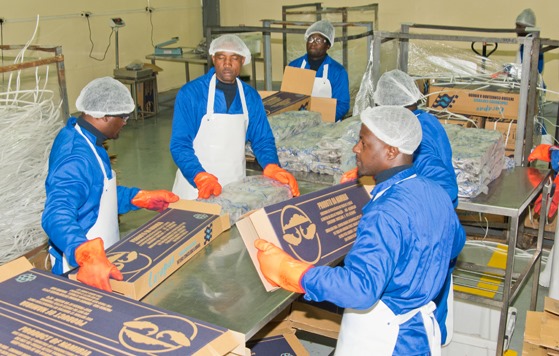
“A repacking effort that is guised as processing seriously undermines the development of the wet fish sector which is highly capital intensive and creates substantial onshore jobs predominantly for women and the youth,” Angala said, adding that the current onshore employment in the Wet Landed Horse Mackerel Association sector is approximately 500 workers per 25 000 tonnes of quota, which is criteria that should be taken note of.
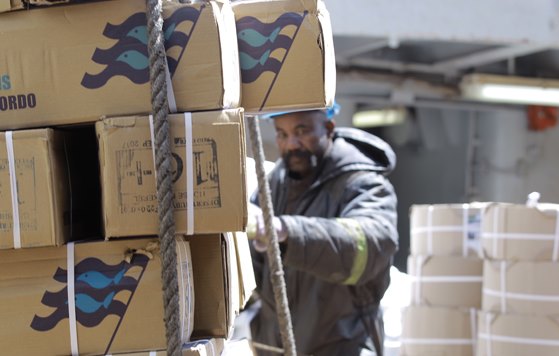
The fishing company that made the offer to the fisheries minister supplies sea-frozen whole-round horse mackerel packed in cartons of 30kg. The carton consists of three smaller boxes of 10 kg, also called blocks.
The company in question does not have a land-based processing facility, but it makes use of between eight and ten temporary workers to unpack the 10kg boxes from the bigger cartons at their cold storage facility in Walvis Bay after unloading what remains of the cargo in the commercial part of the port of Walvis Bay.
The bulk of the companies freezer catches is transhipped to bigger cargo vessels while at sea.
Players in the wet fishing sector at the end of last week stated that the jobs of more than 2 000 people are at stake and deem the fisheries minister’s consideration of quota conversion as a loophole to bypass them again.