Staff Reporter
NAMIBIA and Germany agreed on a draft declaration about the genocide committed by German Imperial Troops in Namibia more than a century ago.
The German government has acknowledged the mass killings of sections of the Nama and Ovaherero people at the beginning of the previous century and is willing to apologise to affected communities. Germany has previously acknowledged moral responsibility for the genocide where an estimated 100 000 people died.
Namibia’s Special Envoy, Ambassador Dr. Zed Ngavirue on the Negotiations on Genocide, Apology and Reparations updated the Namibian Head of State during a status briefing at State House on the negotiations between Namibia and Germany.
President Hage Geingob called for the briefing ahead of the final round of negotiations between the two countries.
The Namibian Presidency in a statement about the status update said that almost five years have passed following the appointment of Special Envoys by the Governments of Namibia and Germany and the commencement of negotiations.
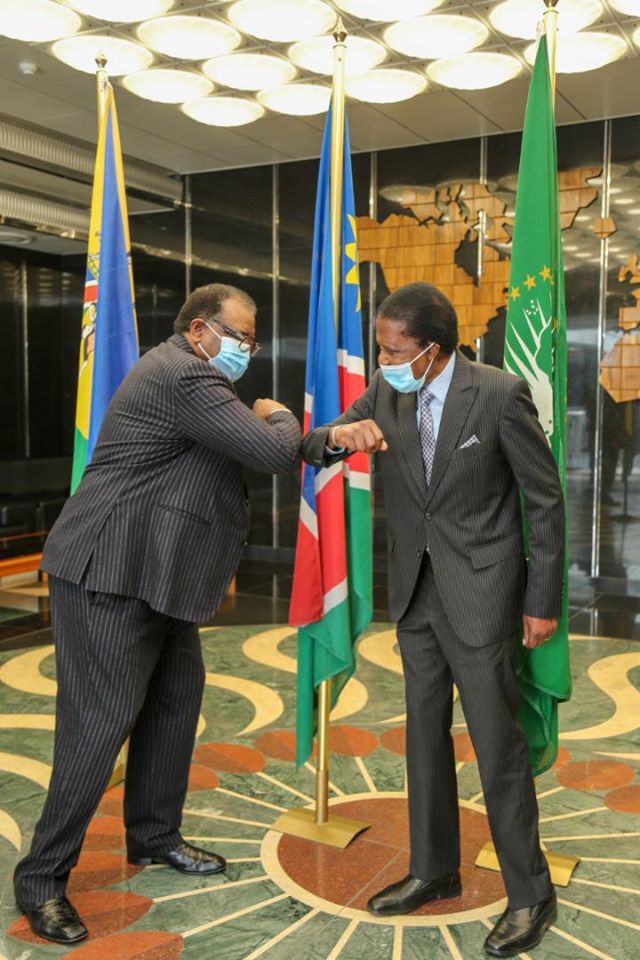
REPARATION UPDATE: President Hage Geingob, the Vice President, Nangolo Mbumba, the Speaker of the National Assembly, Professor Peter Katjavivi and Dr. Alfredo Tjiurimo Hengari, attended the status update meeting by Ambassador Dr. Zed Ngavirue. – Photos: Courtesy of the Namibian Presidency. 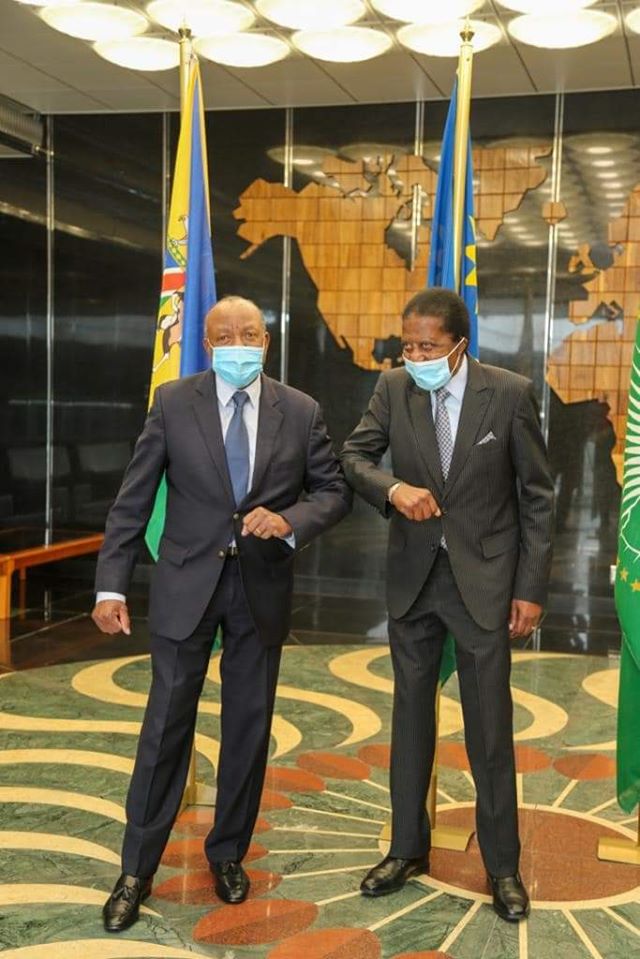
REPARATION UPDATE: President Hage Geingob, the Vice President, Nangolo Mbumba, the Speaker of the National Assembly, Professor Peter Katjavivi and Dr. Alfredo Tjiurimo Hengari, attended the status update meeting by Ambassador Dr. Zed Ngavirue. – Photos: Courtesy of the Namibian Presidency. 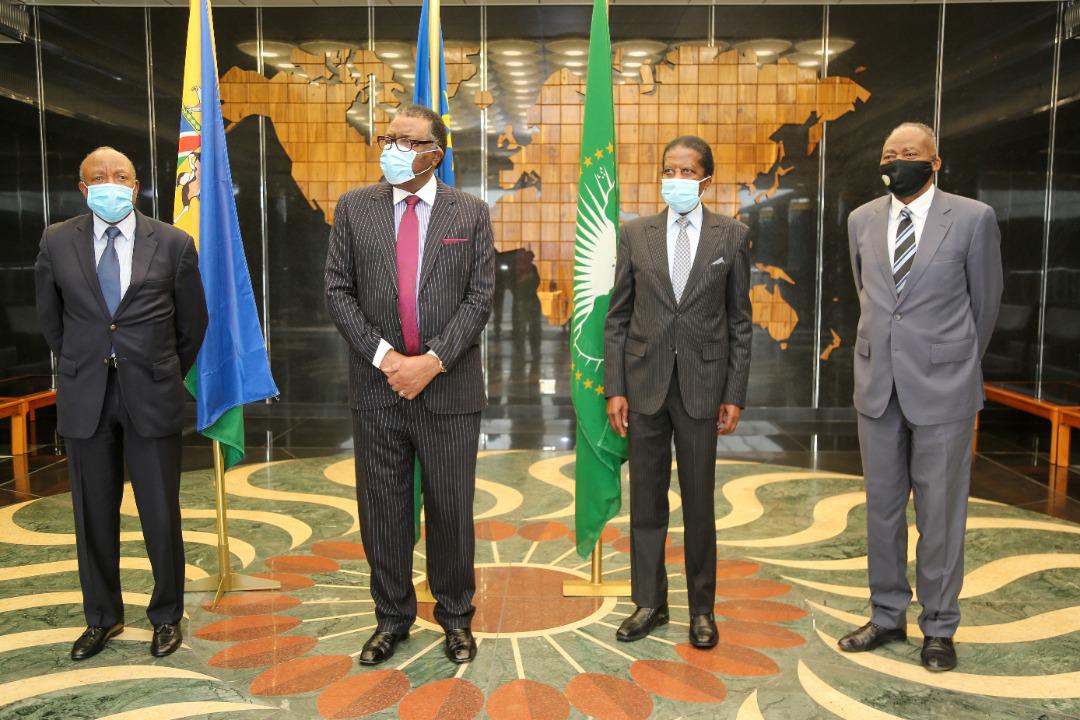
REPARATION UPDATE: President Hage Geingob, the Vice President, Nangolo Mbumba, the Speaker of the National Assembly, Professor Peter Katjavivi and Dr. Alfredo Tjiurimo Hengari, attended the status update meeting by Ambassador Dr. Zed Ngavirue. – Photos: Courtesy of the Namibian Presidency.
Between 2015 and 2020, eight rounds of negotiations have taken place in both During the same time 15 meetings of the Special Political Cabinet Committee (SPCC) on Genocide, Apology and Reparations Chaired by the Vice President have also taken place.
The eighth meeting between the Special Envoys was held in Swakopmund during February 2020.
Ambassador Ngavirue informed President Geingob that at the conclusion of the eighth round of negotiations, the Namibian and German negotiating teams agreed on a draft declaration, stressing a narrative of the genocidal events committed by German Imperial Troops in Namibia, and which took place between 1904-1908.
The German Government citing political and moral responsibility, has agreed to render an unconditional apology to the Namibian Government, her people and in particular the affected communities.
Although Genocide is a punishable crime according to the United Nations Convention on Genocide, signed on 9 December 1948 and effective on 12 January 1951, the German and Namibian Government have agreed on a political settlement.
While the Namibian Government agreed to negotiate the issue of redress, Germany has declined to accept the term “reparations”.
Ambassador Ngavirue explained that this position is based on Germany’s refusal to use the term “reparations” in negotiations with the Jews and the State of Israel, with the two parties settling on the term “Wiedergutmachung” (reconciliation and doing good again) in their agreement signed at Luxemburg in 1952.
Ambassador Ngavirue emphasized that the Namibian negotiating team found the terminology “healing the wounds” inadequate, and that demand is currently discussed under the rubric of “Reconciliation and Reconstruction Programme”.
The terminology, “Reconciliation and Reconstruction Programme” will be submitted for debate and approval to the Special Political Cabinet Committee on Genocide, Apology and Reparations, Chaired by the Vice President, Nangolo Mbumba, and eventually to the Head of State for final approval.
According to the statement by the Namibian Presidency, the current offer for reparations made by the German Government remains an outstanding issue and is not acceptable to the Namibian Government.
“The Special Cabinet Committee during March this year directed the Special Envoy to continue with negotiations for a revised offer. The Special Committee also directed the Technical Committee (TC) to work with the National Planning Commission to identify costed projects for the seven identified regions in the fields of water provision, rural and peri-urban electrification, road network construction, housing, education, vocational training, value addition, agricultural development and land acquisition.”
Ambassador Ngavirue reported that the Technical Committee has enlisted the services of an expert who is currently finalizing the project proposals for consideration by the SPCC before the end of August 2020. The projects will be implemented in the seven identified regions where the affected communities predominantly reside, namely Kharas, Hardap, Khomas, Kunene, Omaheke, Otjozondjupa and Erongo.
President Geingob emphasised the importance of cooperation and compromise in diplomacy and thanked and applauded Ambassador Ngavirue for the significant progress made during Phase I of a critical mission for the country.
“It appears as if you have finished the task that I had assigned to you”, President Geingob said.
President Geingob also thanked the Vice President for the diligent manner in which he continues to carry out the delegated task of Chair of the Special Political Cabinet Committee on Genocide, Apology and Reparations.
With completion of Phase I on the immediate horizon, President Geingob made it clear that ahead of Phase II, all concerned groups and affected communities will be invited to State House for a feedback session.
Additionally, the Prime Minister as Leader of Government Business in Parliament will deliver a statement in the National Assembly on the Status of Negotiations on Genocide, Apology and Reparations.
This is in line with the inclusive and transparent method of governance President Geingob unceasingly insists upon.