


Staff Reporter
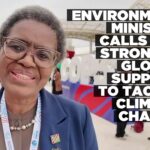
THE Minister of Environment, Indileni Daniel, has highlighted the impact of climate change on Namibia and called for collective action from the international community to address its effects through strategic investments and the advancement of green ambitions.
“Namibia may be a small country in terms of population and a modest contributor to global greenhouse gas emissions, but we have a significant stake in the success of global climate action. Our people are already experiencing the consequences of a changing climate through recurring droughts, floods, rising temperatures and increasing pressure on water, food systems and livelihoods. These impacts are particularly severe for rural communities whose livelihoods depend directly on land, water and natural resources. For Namibia, climate change is a serious development challenge,” Daniel said.
The minister made these remarks at the United Nations Climate Change Conference (COP31), taking place in Antalya, Türkiye, from 9 to 20 November 2026.
“The discussions in Antalya are focused on raising ambition in implementation by mobilising climate finance, strengthening adaptation, advancing a just transition, accelerating emissions reductions and ensuring that countries can access the finance, technology and capacity needed to fulfil their commitments. The COP31 Action Agenda also creates opportunities for practical cooperation on food security, clean energy, green industrialisation, zero waste and circularity, resilient cities, oceans, biodiversity and ecosystem restoration,” Daniel explained.
Daniel noted that Namibia launched its Third Nationally Determined Contribution (NDC 3.0) in September 2026, outlining 72 measures and 216 actions across 13 sectors, with an estimated investment requirement of approximately US$14 billion by 2035. She described the NDC 3.0 as both a climate commitment and an investment opportunity, providing a framework for turning climate mitigation and adaptation priorities into tangible projects, infrastructure, employment opportunities and more resilient communities.
Daniel highlighted that Namibia is pursuing renewable energy and green hydrogen development while also investing in climate-resilient agriculture, water security, biodiversity conservation, sustainable land management and community-based natural resource management.
“We want these transitions to create local value through stronger domestic businesses, skills and technology transfer, opportunities for young people and women, and decent jobs. We are equally clear that investment must be environmentally and socially responsible, inclusive and aligned with the needs of communities,” she added.
Daniel urged international partners to support Namibia’s efforts to accelerate its green energy transition and unlock its development potential.
“We should aim to leave Antalya with stronger partnerships, clearer project development pathways, more advanced financing discussions and practical cooperation that can be carried forward after the conference. Our message to the international community is straightforward: Namibia is ready to work with partners. We have significant renewable energy potential, natural capital, an enabling policy direction and a strong commitment to sustainable development. We welcome partners who share our ambition to translate these opportunities into productive investment, resilient livelihoods, local enterprise, skills development and better lives for our people,” the minister said.
Video: Ministry of Environment.


