Staff Reporter
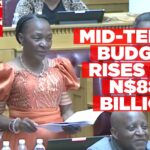
THE Minister of Finance tabled the mid-term budget review, which she said will follow a consolidated path due to a downward revision of revenue.
“In February 2026, I tabled before this August House a budget totalling N$87.9 billion for FY2026/27, comprising N$81.4 billion for operational expenditure and N$6.6 billion for development expenditure financed through the State Revenue Fund. In addition, N$8.9 billion was allocated to development projects financed outside the State Revenue Fund, bringing the total development budget to N$15.4 billion. Consequently, total expenditure, including statutory commitments, amounted to N$106.0 billion, of which N$16.2 billion was earmarked for statutory commitments,” Shafudah said.
She added that the mid-year budget review comes at a time when the total revenue for FY2026/27 has been revised down by N$1.5 billion, from the main budget estimate of N$89.6 billion to N$88.1 billion, owing mainly to lower mining receipts, a reduced fuel levy and lower administrative fees.
“Beware of little expenses; a small leak will sink a great ship.” – Benjamin Franklin. “Honourable Speaker, this timeless wisdom reminds us that fiscal sustainability is built not only on major policy decisions, but also on disciplined management of every public dollar entrusted to Government. In light of the downward revision of the economic growth outlook and revenue by N$1.5 billion, and in staying within our means, the readjustment of existing Vote ceilings and the reallocation of available resources within and between votes is being proposed for consideration,” Shafudah said.
Some of the key allocations include an amount of N$179 million to Vote 38: Agriculture and Land Reform for the containment and management of the outbreak of foot-and-mouth disease. This amount was mobilised through the two per cent (2%) reduction applied to the expenditure ceilings of all OMAs.
An amount of N$180 million is allocated to Vote 01: President. Of this amount, N$140 million is earmarked for the construction of basic sports facilities under the coordination and supervision of Regional Governors, necessitating the transfer of the budget allocation to Vote 01 from Vote 27: Sport, Youth and National Service to ensure streamlined implementation, enhanced accountability and expedited delivery. The remaining N$40 million is to strengthen security measures.
An amount of N$200 million is allocated to Vote 08: Defence, comprising N$100 million for rations and N$100 million for utilities.
An amount of N$62 million is allocated to Vote 17: Urban and Rural Development, comprising N$50 million for urgent soil erosion mitigation works in Rundu, Kavango East Region, and N$12 million to fund the five per cent salary adjustment for Regional Councillors. An amount of N$41 million is allocated to Vote 13: Health and Social Services to cater for 456 medical and dental interns.
The biggest allocation is an additional N$665 million proposed for Vote 09: Finance, comprising N$535 million to address funding requirements for PSEMAS and N$130 million to replenish the Contingency Fund.
Shafudah said that, as a result, the Appropriation Amendment Bill for FY2026/27 will increase the total budget appropriation from N$87.9 billion to N$88.6 billion, representing a modest upward adjustment.
She said that the revised fiscal outlook for FY2026/27 will see total expenditure, including statutory commitments, revised down to N$105.0 billion.
Non-interest expenditure is revised to N$89.6 billion, including loan-funded projects.
The budget deficit is estimated at N$16.3 billion, or 5.5% of GDP, while the primary deficit is projected at 0.3% of GDP.
Total public debt is projected at N$201.7 billion, equivalent to 68.7% of GDP, while Government guarantees are estimated at N$11.8 billion, or 4.0% of GDP.
“Government remains steadfast in restoring fiscal resilience, preserving macroeconomic stability and accelerating the implementation of NDP6,” Shafudah concluded.
Photo: Parliament of the Republic of Namibia