Staff Reporter
PRIVATE veterinarians supporting Namibia’s Foot-and-Mouth Disease (FMD) response have raised concerns over field surveillance capacity, testing information and the pace of restrictions being relaxed following the confirmation of the outbreak in the Karasburg district.
In an industry assessment, the veterinarians said the Directorate of Veterinary Services (DVS) had taken key decisions correctly, including imposing a nationwide movement standstill on the day the outbreak was confirmed and using the NamLITS traceability system to identify cattle that had moved from the infected farm to Otjozondjupa.
However, they warned that the response could be undermined by insufficient field teams, particularly in a region where sheep and goats make up a significant portion of livestock.
The veterinarians said that, as of 25 September, they were aware of only one surveillance team operating in the affected area, while more than 20 private veterinarians had volunteered to assist, with farmers also offering vehicles and accommodation.
They argued that the lack of additional teams creates a biosecurity risk because surveillance teams moving between farms could potentially carry the virus from one holding to another if the status of the previous holding is not known.
According to the assessment, a single team faces a choice between moving quickly and potentially increasing transmission risks, or waiting for test results before visiting another holding and consequently covering too few farms.
The veterinarians also questioned whether the surveillance capacity envisaged in the National FMD Contingency Plan is sufficient for the current circumstances, particularly where small-stock holdings require laboratory testing because infection in sheep and goats can be difficult to detect through clinical inspection alone.
The assessment further raised concerns about the information provided on negative FMD test results.
The veterinarians said Veterinary Public Notification No. 16 does not specify which tests were used, how many animals were sampled or what proportion of the affected herds was tested.
They said this information is important because different tests detect different stages of infection and a negative result does not necessarily exclude infection if testing is conducted at the wrong stage.
The assessment also questioned the decision to describe cattle traced from the infected farm to Otjozondjupa as having been “cleared of infection” after one round of testing.
The veterinarians argued that the National FMD Contingency Plan requires trace-back holdings to be inspected and sampled at day zero, day 14 and day 28, and said a single negative test may not detect animals infected shortly before testing.
They acknowledged that the DVS may intend to complete the required follow-up schedule but said this was not clear from the public notification.
The assessment also questioned the interpretation of the absence of traceability evidence indicating transmission north of the Veterinary Cordon Fence.
The veterinarians said the absence of recorded movements does not by itself establish that no transmission occurred and argued that active surveillance is required to demonstrate disease freedom.
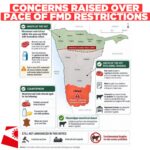
They further expressed concern about the partial lifting of restrictions announced in Veterinary Public Notification No. 16 on 27 September, saying the available surveillance results were not sufficient, in their view, to support broader relaxation of controls.
The assessment noted that 199 samples had been collected between 22 and 25 September across //Kharas, Khomas, Omaheke, Otjozondjupa and Oshana, with 17 testing positive, all in the Karasburg district.
The veterinarians said this represented a useful start but argued that more extensive surveillance would be needed before restrictions are lifted in areas linked to livestock movements from the infected farm.
They supported the release of certain processed products, including cooked meat, pasteurised milk and milk products, and wet-blue hides, saying these measures could restore commercial activity while maintaining disease controls.
The assessment also identified three issues the veterinarians said remained particularly important: confirmation of the virus serotype, publication of compensation arrangements and the establishment of a specific surveillance standard for sheep and goats.
They said the small-stock issue was particularly important because //Kharas has substantial sheep and goat production, while clinical signs in these species may be difficult to detect.
The veterinarians said Namibia’s FMD-free status south of the Veterinary Cordon Fence is critical to the livestock sector because it underpins access to international beef markets.
They cited figures indicating that Namibia earned about N$2.1 billion in foreign exchange from beef exports in 2025 and has concurrent beef export access to the United States, China, Norway and the European Union.
The assessment also compared Namibia’s response with previous outbreaks in Botswana, Germany, South Africa and Zimbabwe, arguing that the first weeks of an outbreak can significantly influence the eventual duration and economic impact of disease controls.
The veterinarians emphasised that their assessment was prepared in support of the DVS rather than in opposition to it, and acknowledged that the Directorate had taken what they described as important early measures correctly.
They said the objective was to ensure that decisions on the next stages of the response are supported by sufficient surveillance evidence.
The assessment concludes that the coming weeks will be critical to determining whether Namibia can contain the outbreak and work towards restoring its FMD-free status.
Graphic: Directorate of Veterinary Services