Staff Reporter
ROSATOM and Kazakhstan have signed an Engineering, Procurement and Construction (EPC) contract for the development of the Balkhash Nuclear Power Plant (NPP), which will comprise two VVER-1200 reactor units with a combined capacity of 2,400 megawatts (MW).
Rosatom Africa said the development is particularly significant for Namibia, which accounts for around 12% of global uranium production while importing up to 22% of its electricity.
“Kazakhstan’s experience shows how uranium resources can be linked with skills training and reliable low carbon generation. Namibia and Russia are already discussing cooperation in the nuclear field, including uranium exploration in the Omaheke Region through Headspring Investments (part of Rosatom), as well as educational programmes. Kazakhstan’s experience offers a practical long term perspective,” Rosatom Africa added.
Rosatom Africa’s full statement on the development is provided below:
Namibia’s uranium and the energy of the future: what Kazakhstan’s first nuclear power plant means for Windhoek
Every 25th light bulb in the world is lit thanks to uranium mined in Kazahstan. Now the world’s largest uranium producer is building its own nuclear power industry. For Namibia, one of the world’s top three uranium producers, the story is worth a closer look.
Global electricity consumption is expected to double by 2050. Much of that demand will come from data centres and metallurgy, industries that need large volumes of reliable, round-the-clock power. For countries with uranium resources, the question is how to turn a raw-material export into a domestic energy asset.
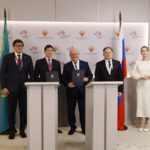
On September 3, on the sidelines of the Eastern Economic Forum, Rosatom State Corporation and Kazakhstan Nuclear Power Plants LLP (KNPP) signed an EPC contract for the construction of the Balkhash Nuclear Power Plant: two Generation III+ VVER-1200 units with a total capacity of 2,400 MW. As consortium leader, Rosatom is responsible for the full cycle, from design and procurement to construction, commissioning and handover. The same technology is in operation or under construction in Russia, Egypt, Belarus, Turkey, Bangladesh, Hungary and China, with a 60-year design life extendable by a further 20.
Namibia produces around 12% of the world’s uranium, yet imports up to 22% of its electricity, largely from South Africa. Erongo has been a uranium hub for decades; Omaheke is emerging as the next frontier.
The Kazakhstan contract shows what that chain looks like in practice: mining and processing, nuclear education, and eventually power generation. Namibia’s energy choices remain a sovereign decision on the country’s own timeline. The Kazakhstan case is an illustration of the integrated model Rosatom applies in its international projects.
Localisation is central to the approach. At Akkuyu in Turkey, more than 80% of the workforce are Turkish citizens. After the Belarusian NPP entered operation, over 1,000 skilled jobs were created at the plant and more than 10,000 in related services. In Egypt, El Dabaa is Africa’s largest nuclear construction site currently employs thousands of workers; the majority of them are Egyptians. Kazakhstan is already training its next generation: around 100 students study nuclear disciplines at the MEPhI branch of Al-Farabi Kazakh National University.
Namibia and Russia have been discussing opportunities for cooperation in the peaceful uses of nuclear energy, including joint work on uranium deposits and preparations for a framework intergovernmental agreement. One practical area of this cooperation is uranium exploration in the Omaheke Region, undertaken by Headspring Investments – the Namibian operating company of Uranium One Group (part of Rosatom Group). Geological studies at the Wings project have identified a sandstone-hosted uranium deposit, with in-situ recovery being assessed as a potential extraction method.
Alongside its exploration work, Headspring Investments supports Namibian human-capital development through bursaries for university students pursuing mining-related fields and a technical training programme for young people from the Leonardville area. These initiatives connect uranium-resource development with skills development and help strengthen the technical capacity relevant to Namibia’s future energy and industrial choices.
Rosatom and the Agency of the Republic of Kazakhstan for Atomic Energy sign contract for the construction of a Nuclear Power Plant. Photo: Rosatom Africa.