Growth Forecast Cut Again, Q2 Print Still to Come
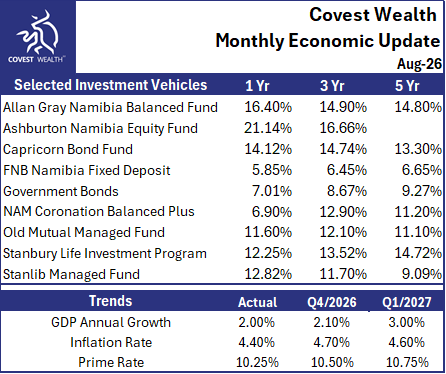
The Bank of Namibia has lowered its 2026 growth forecast to 2.1%, half a percentage point below its June projection and well short of the government’s 3.1%. First-half indicators point to sluggish mining, manufacturing, electricity and transport activity, with agriculture and retail trade the only sectors improving. The Q1 print of 2.0% remains the latest hard number; the NSA releases Q2 GDP in late September. “Two downgrades in three months tells you the recovery is losing altitude before it gained any,” says Pieter De Klerk, CEO of Covest Wealth. “The Bank now names foot-and-mouth disease and El Niño as the next risks; neither is a mining problem, so the primary sector’s drag may soon have company. A 2.1% economy has very little margin for error.”
Inflation Plateaus at 4.4%; the Bank Holds
Headline inflation held at 4.4% in July, unchanged from June, with monthly price growth slowing to 0.1%. Transport remains the driver, up 9.3% year-on-year and contributing 1.4 percentage points of the total, while food inflation eased to 3.7% from 6.1% a year earlier. Core inflation stood at 3.7%, and Khomas recorded 5.3%, the highest of the three zones. On 12 August the Monetary Policy Committee unanimously kept the repo rate at 6.75% and prime at 10.25%, holding its 2026 inflation forecast at 4.0%. “The June hike bought the Bank room, and it is using it,” says De Klerk. “Core at 3.7% says second-round effects are contained, and with the SARB on hold there is no differential to defend. But 4.4% is a plateau, not a peak; September’s fuel increase lands squarely in the transport basket.”
The Fuel Subsidy Ends
The holding pattern is over. July brought relief (petrol cut by N$1.00 to N$22.48 and diesel by N$4.00 to around N$24.36), but August reversed it with a N$2.00 across-the-board increase as government reinstated the four levies it had halved from April. From 2 September petrol rises a further 60 cents to N$25.08 at Walvis Bay and both diesel grades by N$1.60 to N$27.86 and N$27.96, with the Road User Charge levy up 30 cents to N$2.73 per liter. The Ministry recorded under-recoveries of 68 cents on petrol and over N$2.15 on diesel. “The subsidy was always borrowed time, and the bill has arrived,” says De Klerk. “Diesel at N$27.96 is a production cost; it sits in every kilogram of beef, every ton of ore and every delivery, and roughly 70% of the fuel this country burns is diesel. Motorists will notice the petrol price; the economy will feel the diesel price.”
Credit Steadies at 4.5%, Households Lead
Private sector credit growth edged up to 4.5% year-on-year in June from 4.3% in May, still below April’s 4.8%, lifting the loan book to N$125.5 billion. Household credit reached 4.5%, its strongest since August 2023, on mortgage growth of 2.1% (the best since January 2024) and installment and leasing finance up 14.8%. Corporate credit also grew 4.5% as other loans and advances rebounded to 2.5% after two months of contraction, led by mining, retail, financial services and energy borrowers; corporate overdraft growth slowed to 2.2% from 6.1%. “The composition has improved,” says De Klerk. “Two months ago it was corporates on overdraft; now households are taking mortgages and vehicle finance, and corporates are borrowing on term rather than revolving facilities. That is healthier credit, even if 4.5% is barely half South Africa’s 7.8%.”
Record Imports Widen the Deficit; Reserves Still Rising
The trade deficit widened to N$5.5 billion in June as the import bill hit a record N$18.3 billion, up 62% year-on-year on fuel, mining inputs and commercial vehicles, against exports of N$12.9 billion. First-half exports rose 7.6% to N$67.2 billion, but imports of N$87.2 billion left a cumulative deficit near N$20 billion, more than double a year earlier. International reserves nonetheless climbed to N$57.1 billion at end-July (3.5 months of import cover) on SACU receipts and customer foreign currency placements. “Exports are doing their job; uranium is carrying the half-year,” says De Klerk. “The problem is what we pay for fuel and equipment, priced in dollars we don’t earn. With reserves above N$55 billion the peg is not in question, but the trade account is now the number to watch.”