Staff Reporter
THE Ministry of Education, Innovation, Youth, Sport, Arts and Culture has apologised for the delay in repatriating Namibian ancestral and mortal remains from South Africa, saying circumstances beyond its control affected the planned flight arrangements.
Education Minister Sanet Steenkamp said the ministry had intended to return to Namibia with the remains on 20 August, but was unable to depart as scheduled. She apologised to President Netumbo Nandi-Ndaitwah and the Namibian nation for the disappointment and inconvenience caused by the delay.
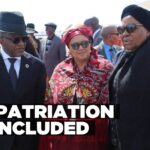
“On behalf of the Ministry and the entire team, I sincerely apologise to Your Excellency and to the Namibian nation for this delay, and for the disappointment and inconvenience it may have caused,” Steenkamp said during the official reception ceremony at Hosea Kutako International Airport on Friday.
She said the remains remained secure and under appropriate care throughout the delay, while efforts were made to resolve the flight arrangements and facilitate their return.
Namibia received the mortal remains of former political prisoners Simon Petrus Niilenge and Festus Nehale, together with the ancestral remains of 84 people, casts and cultural heritage materials repatriated from South Africa.
Steenkamp described the return as more than a transfer of remains and heritage materials, calling it a homecoming that reconnects the ancestors with their homeland, communities and people.
The minister said the repatriation process was rooted in a commitment by Namibia and South Africa to address unresolved aspects of their shared history.
The process gained renewed momentum following the Robben Island Reunion held in Cape Town in September 2025, during the 30th anniversary of the first gathering of former Namibian and South African political prisoners.
According to Steenkamp, the two governments subsequently agreed to proceed with the exhumation and repatriation of Niilenge and Nehale, as well as the return of ancestral human remains and heritage materials held at Iziko Museums.
Cabinet provided the necessary mandate, while a Repatriation Roadmap was adopted to guide the process.
Steenkamp said the operation involved diplomacy, historical research, scientific expertise, cultural protocols, legal processes, family consultations and engagement with traditional authorities.
Between 8 and 13 July, a Namibian delegation comprising officials from the education ministry, the Ministry of Defence and Veterans Affairs, the Ministry of International Relations and Trade, family and traditional authority representatives, and technical experts travelled to Cape Town.
The delegation worked with South African counterparts and Iziko Museums to verify documentation, provenance, permits, conservation requirements and arrangements for the safe return of the remains.
The delegation also visited the gravesites of Niilenge in Gugulethu and Nehale in Maitland, where their families were given an opportunity to conduct rites and honour them according to their traditions.
The delegation further visited Robben Island, where former political prisoners shared their experiences and reflected on places associated with the liberation struggle.
Steenkamp said the technical aspects of the process were important, but emphasised that the repatriation ultimately concerned people, families, identity and belonging.
“Behind every document was a human being. Behind every accession number was an ancestor. Behind every grave was a family,” she said.
She said provenance research, cultural protocols and the careful handling, packaging, documentation and transportation of human remains were not merely administrative requirements, but acts of respect.
Steenkamp thanked the South African Government, relevant authorities, Iziko Museums, the Robben Island Museum, South African officials and institutions involved in the process.
She also thanked Namibian officials, technical experts, families, traditional authorities and others who contributed to the repatriation.
“To the families, I wish to say: Thank you for your patience. Thank you for your strength. And thank you for entrusting us with this responsibility. Today, your loved ones are home,” she said.
Steenkamp said the repatriation demonstrated what could be achieved through cooperation between Namibia and South Africa.
She said the return of the remains was about restoring belonging, enabling families to honour their loved ones according to their traditions and acknowledging Namibia’s history with dignity and respect.
The remains of Nehale and Niilenge are scheduled to be reburied at Heroes’ Acre on Monday, 24 August, with their tombstones to be unveiled on Heroes’ Day on 26 August.
The 84 ancestral human remains will remain in the care of the Ministry of Education, Innovation, Youth, Sport, Arts and Culture.
Photo: Ministry of Education Innovation, Youth, Sports, Arts and Culture