Staff Reporter
PRESIDENT Netumbo Nandi-Ndaitwah has joined fellow Southern African Development Community (SADC) leaders at the 46th Ordinary Summit in eThekwini, South Africa, where regional leaders are focusing on migration management, peace and security, job creation, industrialisation and deeper economic integration.
South African President Cyril Ramaphosa, who assumed the SADC chairship at the summit, called for faster implementation of regional development plans, arguing that economic integration must translate into tangible improvements in the lives of citizens across the region.
The summit coincides with the 34th anniversary of the signing of the SADC Declaration and Treaty in Windhoek on 17 August 1992.
Ramaphosa said the anniversary should serve as a reminder of the region’s history of solidarity and its responsibility to advance the vision of a peaceful, integrated and prosperous Southern Africa.
Ramaphosa said SADC’s 16 member states, representing more than 400 million people, have the natural resources, agricultural potential, skills and human capital needed to drive their own development.
However, he said the pace of regional transformation remains too slow, with intra-SADC trade accounting for only about one-fifth of the region’s total trade.
“We continue to import too many goods that we could produce within our region. We continue to export raw materials that we could process and beneficiate ourselves,” Ramaphosa said.
He called for greater investment in regional value chains, infrastructure, energy, water, digital connectivity and climate-resilient food systems.
Ramaphosa said the region must process more of its minerals, add value to agricultural products and expand manufacturing to create jobs and retain economic value within Southern Africa.
He also called for improved roads, railways and ports, as well as stronger cross-border water infrastructure and expanded electricity generation and transmission capacity through the Southern African Power Pool.
On trade, Ramaphosa urged SADC to make greater use of opportunities presented by the African Continental Free Trade Area, which provides access to a continental market of more than 1.4 billion people.
He said this would require the removal of non-tariff barriers, improved border management, harmonised standards and easier movement of goods, services, capital and skills.
The summit also highlighted the importance of peace and security as prerequisites for regional development.
“Peace without development is fragile. Development without peace is impossible,” Ramaphosa said, calling for continued investment in preventive diplomacy, mediation and political dialogue.
He said regional decisions must move beyond communiqués and be translated into practical outcomes, including infrastructure projects, factories, power lines, water systems, businesses and jobs.
Ramaphosa also addressed the Ebola outbreak in the Democratic Republic of the Congo, expressing condolences to affected communities and calling for stronger regional disease surveillance, laboratory capacity, emergency coordination and clinical preparedness.
He urged governments to avoid indiscriminate restrictions on travel and trade against affected countries, arguing that such measures could damage economies and drive movement through unmonitored border crossings.
The South African president also used the summit to acknowledge outgoing SADC chairperson President Emmerson Mnangagwa of Zimbabwe for his leadership and stewardship of the regional bloc.
Accepting the chairship, Ramaphosa pledged that South Africa would work with all SADC member states based on sovereign equality, mutual respect and consensus-building.
He said South Africa’s chairship would focus on greater economic integration, trade and investment, sustainable and inclusive industrialisation, as well as regional peace, security and stability.
“We will seek greater integration of our economies, building ties of trade and investment that drive resilient, sustainable and inclusive industrialisation,” Ramaphosa said.
He urged leaders to ensure that regional integration is felt in the daily lives of citizens through improved employment opportunities, reliable electricity, affordable food, healthcare, education and opportunities for young people.
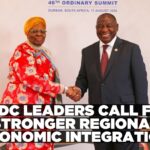
Photo: Namibian Presidency