Staff Reporter
BOTSWANA is intensifying efforts to contain foot-and-mouth disease (FMD), with the outbreaks raising concerns for cross-border animal health and livestock trade in the region, including Namibia, which shares a border with Botswana and remains free of FMD.
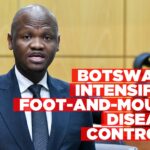
Botswana’s Minister of Lands and Agriculture, Dr Edwin Dikoloti, outlined the measures in the Botswana Parliament, saying the disease had placed significant pressure on rural livelihoods, the livestock industry and the wider economy.
FMD is a highly contagious disease affecting cloven-hoofed animals and is endemic to much of the Southern African Development Community (SADC) region. Dikoloti said outbreaks had been recorded in at least seven SADC countries over the past decade, including Namibia, South Africa, Zambia and Zimbabwe.
He said Botswana had historically managed to control the disease and had secured World Organisation for Animal Health (WOAH) recognition for zones free from FMD without vaccination.
“Despite these immense challenges, Botswana has remained one of the few countries in the region that has been able to control the disease and eventually achieve the World Organisation for Animal Health (WOAH) status of a country with zones that are free from FMD without vaccination,” Dikoloti said.
He attributed Botswana’s previous success to sustained investment in human resources, infrastructure and disease-control measures, which helped the country maintain access to lucrative export markets.
Historically, FMD has been concentrated in northern Botswana, particularly the Ngamiland region, where contact between cattle and African buffalo populations in the Chobe National Park has contributed to outbreaks.
Sporadic outbreaks have also occurred in Zones 3, 6 and 7 along the Zimbabwean border, which Dikoloti attributed largely to illegal cross-border movement of livestock and people.
He said outbreaks in South Africa since 2023 had increased the risk of the disease entering southern Botswana, particularly from Limpopo, North West and Northern Cape provinces, which share a border of about 2 000 kilometres with Botswana.
To reduce this risk, the government constructed a 187-kilometre cordon fence from Tlhareseleele village to Banyana farms. However, repeated breaches and damage to the fence continued to pose a threat.
During 2026, Botswana recorded four FMD SAT1 outbreaks in Zone 6b in the North East, Zone 3c-Maitengwe in the North East, Zone 11 covering Goodhope, Borolong, Southern and Gamalete, and Zone 13 in Kgalagadi.
Dikoloti said emergency mass vaccination had successfully suppressed the outbreaks in Zones 3c-Maitengwe and 6b.
Both outbreaks have since been formally closed with WOAH, although vaccination will continue in the affected areas to maintain herd immunity and protect against further cross-border introductions of the virus.
The government is also preparing a dossier for WOAH to seek official “FMD Free-With-Vaccination” status for the affected zones, which Dikoloti said would be an important step towards reopening international markets for livestock and animal products.
However, active transmission remains in parts of Zones 11 and 13, particularly around Phitshane-Molopo and Tshidilamolomo in Zone 11 and some ranches in the Banyana farms area in Zone 13.
Dikoloti said the affected areas were responding positively to targeted vaccination campaigns.
“Government remains seized with the situation and continues to intensify surveillance, vaccination and other disease-control interventions in the affected areas,” he said.
The government is also establishing a Containment Zone aimed at isolating affected areas while protecting the disease-free status of the rest of the country.
The zone will include a southern boundary along the Botswana-South Africa border from Sakutswane Lands near Ramotswa and Otse to Verda, as well as a northern boundary extending from Sakutswane Lands through Mogobane and Ranaka, the Kanye and Mmathethe passes, Tsoaneng and Sekutlhane to Masampa-Verda.
Dikoloti said the approximately 400-kilometre northern boundary would combine existing barriers with newly constructed fencing and was expected to be completed by the end of August.
Once the boundary fence is completed and the Director of Veterinary Services confirms separation of the livestock populations, Botswana will formally approach WOAH for international recognition of the Containment Zone.
“If approved, this will immediately unlock trade for all disease-free zones outside the contained area, unleashing Botswana beef back into the global market,” Dikoloti said.
The government has also introduced controlled livestock movement measures to support local value chains while maintaining disease-control standards.
Livestock from non-outbreak areas can now be processed at designated abattoirs within Zone 11, while livestock from BAITS-registered units may undergo controlled slaughter at approved establishments within the Containment Zone.
Dikoloti acknowledged the impact of the outbreak and movement restrictions on rural communities and the national economy.
He said many farming households relied on cattle for daily livelihoods, school fees and seasonal income, while local businesses had also been affected by the temporary closure of village butcheries and regional market stalls.
The restrictions have also disrupted livestock exports to premium, duty-free and quota-free markets such as the European Union and China, affecting export revenues at the Botswana Meat Commission.
The situation has been compounded by an intensifying El Niño climate pattern, which is putting pressure on rangelands and water resources.
Dikoloti warned that restrictions on livestock off-take could contribute to overgrazing and increase pressure on already strained grazing resources.
The government has activated a broader recovery plan involving several institutions and interventions.
These include the repair of more than 1 152 kilometres of veterinary cordon and international border fences, the realignment of large veterinary control zones into smaller units, advanced mapping of fence lines and strengthened animal traceability.
Botswana is also working with South Africa through the Botswana-South Africa Binational Commission on a joint biosecurity plan and is advocating for the establishment of a SADC FMD Vaccine Antigen Bank.
The country has also provided vaccine assistance to Zimbabwe and Lesotho, while working with German experts through the AU-Germany Agricultural Policy Dialogue to strengthen laboratory networks and disease-control systems.
Dikoloti said Botswana would continue investing in its Botswana Animal Identification and Traceability System (BAITS) and residue-monitoring laboratories to maintain compliance with international food safety requirements.
The government is also developing a national beef brand, “Brand Botswana Beef”, aimed at increasing the value of the country’s traditionally raised, grass-fed cattle in premium international markets.
Dikoloti stressed that controlling FMD would require cooperation between government, farmers, traditional leaders, industry and communities.
He cautioned against prematurely relaxing movement restrictions, saying this could trigger renewed outbreaks, prolong trade bans and undermine the long-term value of Botswana’s livestock sector.
“I urge you all to exercise a little more patience and allow us to complete what we started,” he said, expressing confidence that the country was approaching the end of the crisis.
PICTURED: Botswana’s Minister of Lands and Agriculture, Dr Edwin Dikoloti. Photo: BWParliament (Facebook)