Staff Reporter
Green hydrogen and associated infrastructure development may affect water resources in the //Kharas Region through water abstraction, altering natural drainage and groundwater recharge, and producing salty wastewater (brine) from desalination that could affect the environment.
This is one of the key findings of the recently released Strategic Environmental and Social Assessment (SESA) for Green Energy Production and Industrialisation in the Southern Corridor Development Initiative (SCDI). The assessment provides a strategic, national-level overview of the environmental risks, constraints and opportunities associated with Namibia’s emerging green hydrogen sector, with a particular focus on biodiversity and water availability.
The assessment explains that water resources in the //Kharas Region are scarce and highly sensitive, comprising ephemeral river systems, groundwater aquifers, groundwater-dependent ecosystems and coastal and marine environments.
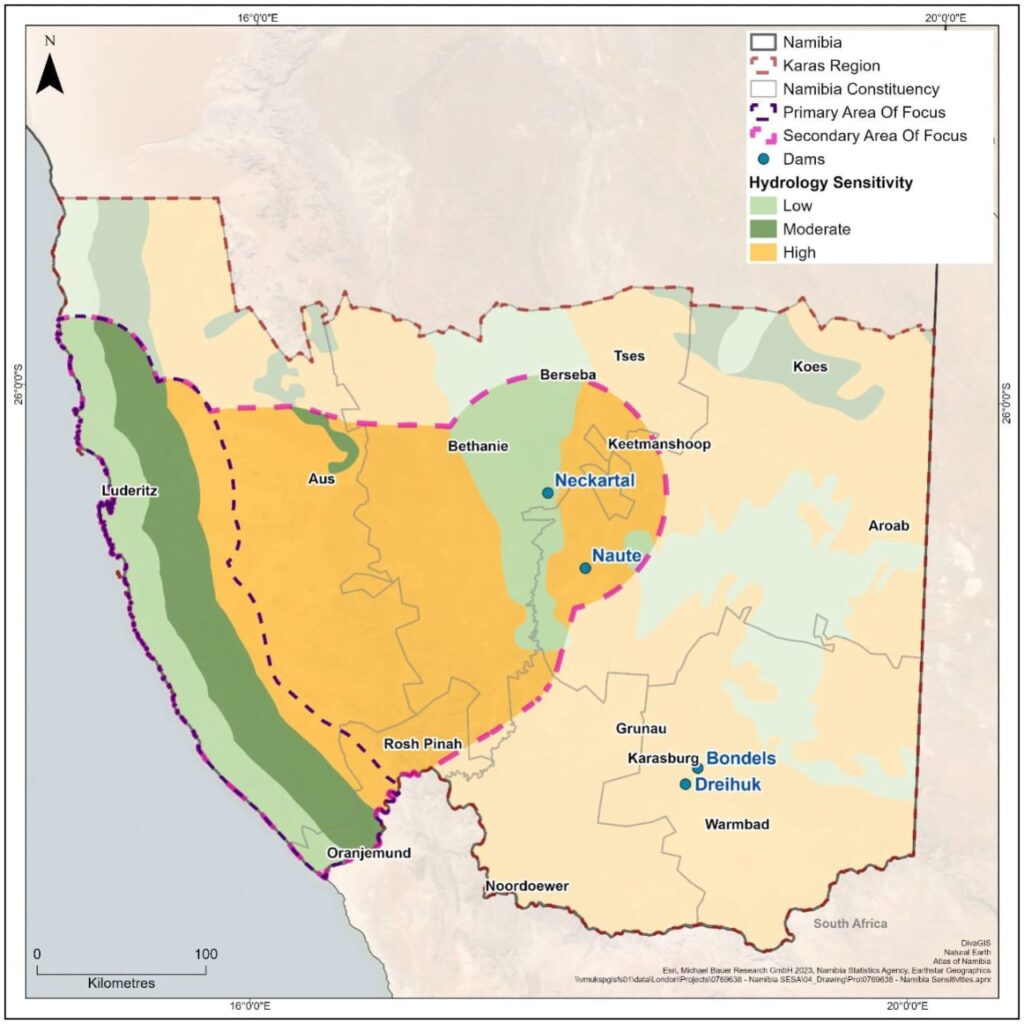
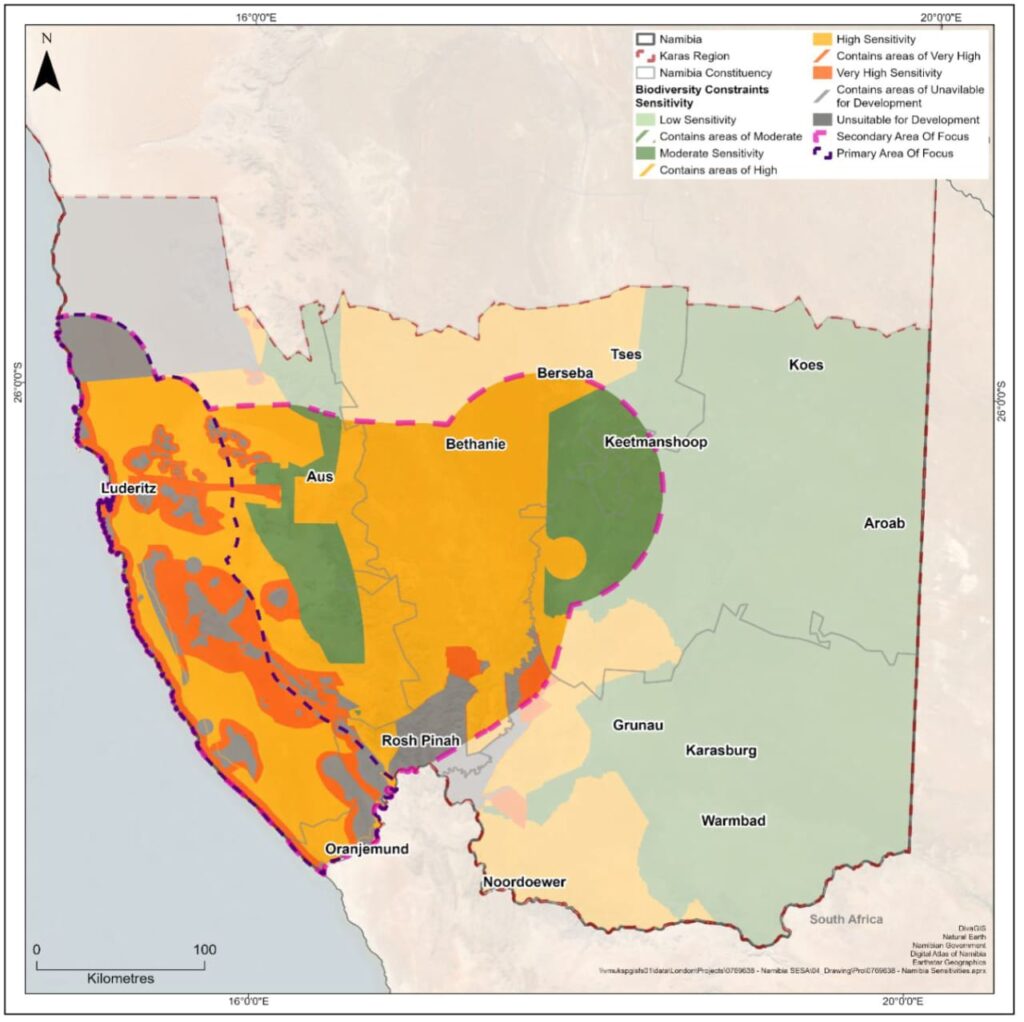
SENSITIVE: Biodiversity Sensitivity Map and Water Sensitivity Map. Images: Environmental Resources Management.
“Low rainfall, limited recharge and arid climatic conditions mean that water systems have little capacity to absorb additional pressures. Green hydrogen and associated infrastructure developments may affect these resources through water abstraction, disruption of drainage and recharge processes, or desalination and brine discharge activities,” the report continued.
The report highlights that water resources underpin both ecological integrity and socio-economic activities, meaning their availability and protection represent key environmental considerations and development constraints in the //Kharas Region.
The assessment also examined the potential impact of the emerging green hydrogen industry on protected areas and species of conservation concern.
It highlighted that the //Kharas Region contains some of Namibia’s most important biodiversity assets, including the Tsau //Khaeb National Park (TKNP), Key Biodiversity Areas (KBAs), biodiversity corridors and extensive natural and semi-natural habitats.
“These landscapes support exceptional biodiversity, high levels of endemism and largely intact ecological systems. While parts of the region have been disturbed by more than a century of diamond mining and exploration, much of the landscape remains ecologically intact and highly sensitive to further disturbance, in part due to restricted access to areas within the TKNP as a result of diamond mining concessions,” the report highlighted.
According to the report, many habitat types have an extremely limited capacity to recover once disturbed, while many species depend on long-term environmental stability. As a result, development within or near protected areas, KBAs and other priority habitats poses a significant biodiversity risk that requires careful, avoidance-based spatial planning.
The report also notes that the //Kharas Region supports numerous threatened, endemic and range-restricted species uniquely adapted to arid and hyper-arid environments. Many of these species depend on specialised habitats and stable environmental conditions, making them highly vulnerable to habitat loss, fragmentation, increased human access, dust, noise and other development-related pressures.
“Protected areas, KBAs and other priority conservation landscapes provide critical habitat for these species and help maintain important ecological processes. Given the limited resilience and recovery potential of many populations, poorly sited green hydrogen and renewable energy developments could result in irreversible impacts on species of conservation concern and broader biodiversity objectives,” the report continued.